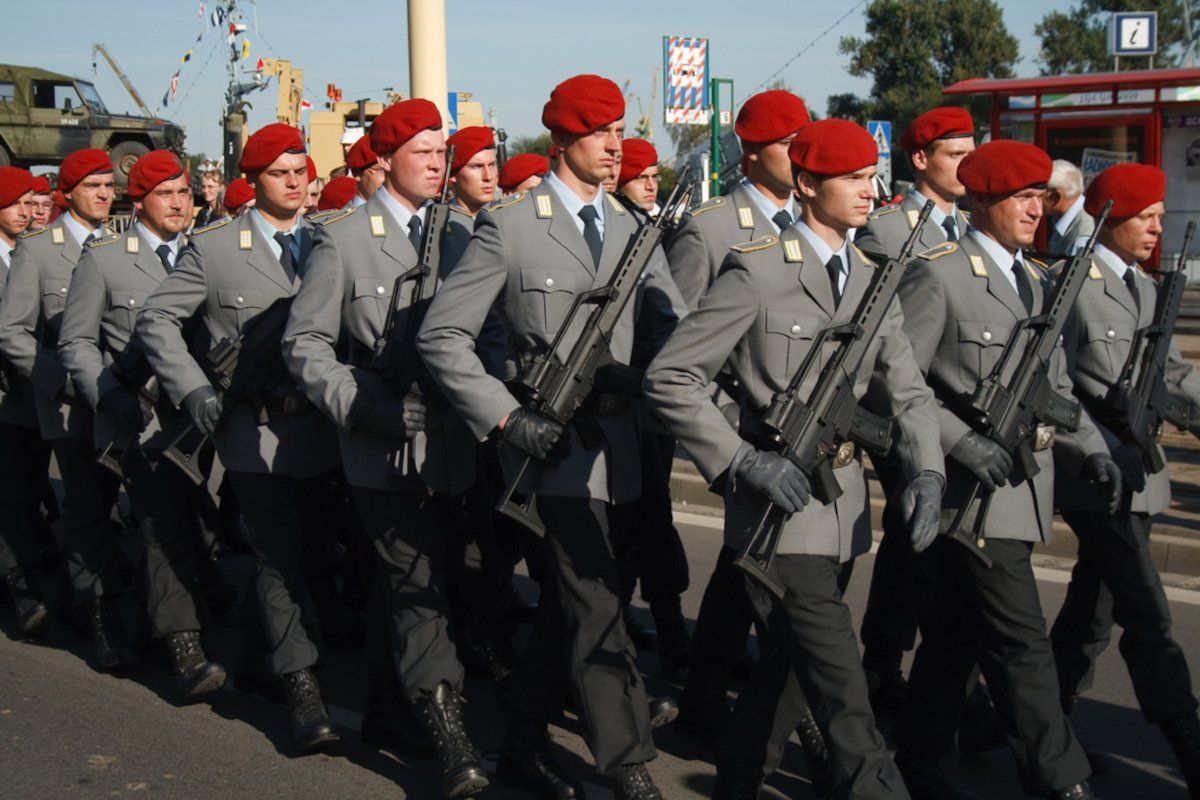
At the moment of the collapse of the Soviet Union, the German army possessed 495,000 soldiers, plus up to 900,000 reservists. At the end of May 2024, 169,974 professional (57,352) and temporary (112,644) soldiers were serving in the Bundeswehr. Together with persons performing voluntary military service, the total number of soldiers amounted to 179,987. The civilian employees employed by the Bundeswehr currently number 80,527 persons.
Voluntary military service can be performed close to one's place of residence and focuses primarily on tasks that serve the protection of the country and its inhabitants in their own neighbourhood. Persons performing voluntary military service do not carry out duties outside Germany's borders.
Within the framework of the politically set targets, the Bundeswehr was to reach a figure of 200,000 soldiers and more, but in reality the number of German soldiers is falling sharply from year to year.
Germany's foreign contingents shrank greatly after the withdrawal from Afghanistan. Currently, a mere 838 Bundeswehr soldiers are directly deployed abroad. The largest contingent of German soldiers is still located in Kosovo, where it numbers 300 persons.
In order to be able at least to defend themselves effectively in the event of an attack, Germany is working on the so-called "Operational Plan for Germany". This secret document, drawn up by military experts together with representatives of the police, the fire service and industry, is intended to bring together all the state and public-private services and structures at a moment of danger and to carry out coordinated state defence operations. - Germany will not be a frontline state, but it will be an important communications hub for NATO, for example in the case of deploying troops to the front line or repatriating wounded soldiers - says Hans-Dieter Müller, commander of the territorial command of the federal state of North Rhine-Westphalia.
Germany proceeds from the assumption that it will not fight on the eastern front, but will instead be responsible for the deployment and transit of allied units through Germany, in the form of support in the area of traffic management, accommodation, catering, refuelling and technical problems.
Since January of this year, a discussion has been under way in Germany about the necessity of holding German citizenship for service in the Bundeswehr.
We [Germany] would not be the first armed forces in Europe to do this. In our country there are people who are the second or third generation living in Germany but do not yet have German citizenship
- said the head of the German Ministry of Defence Boris Pistorius to the German media.
Persons of an origin other than German, but holding German citizenship, already make up 15% in the Bundeswehr. The majority of them are of Turkish, African, Arab and, especially, Russian-German origin.