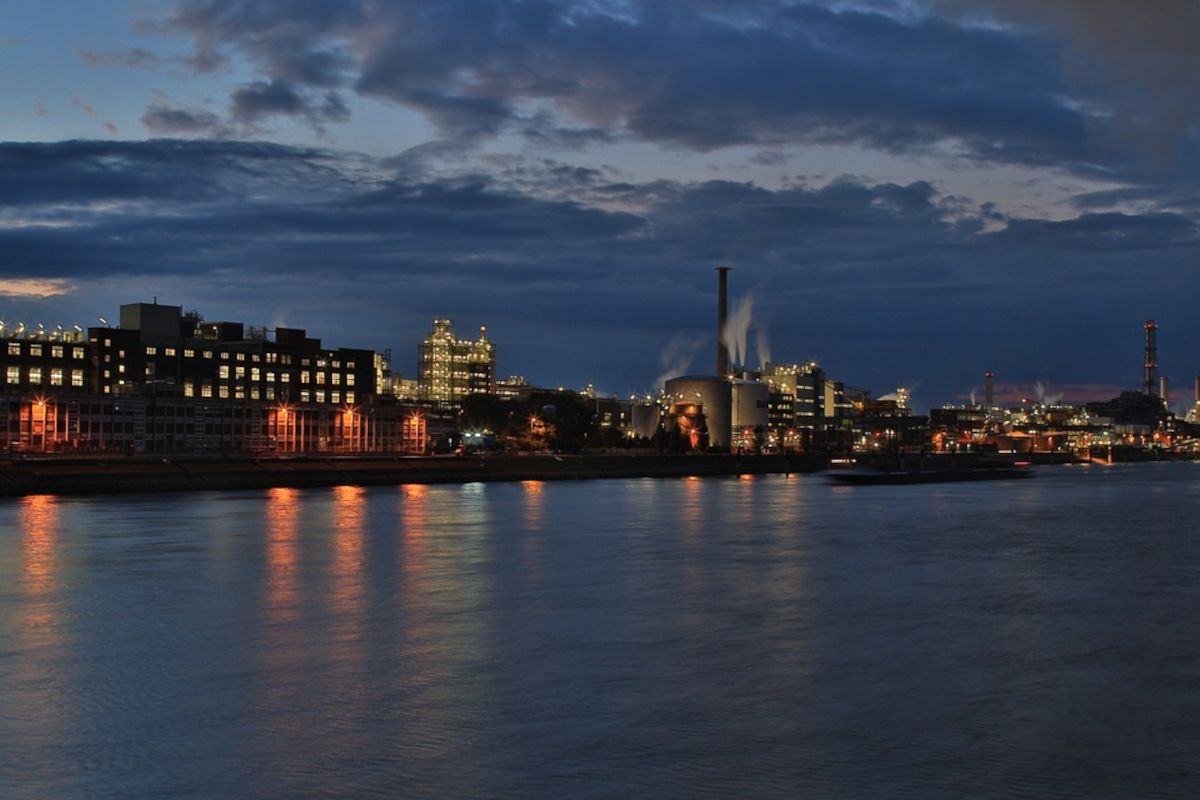
The company is headquartered in Ludwigshafen, with its mighty industrial district and a Rhine river port.
Since 2008, BASF has been an SE (Societas Europaea) - a European company. The chemical giant BASF is a global player with 239 production facilities in 91 countries worldwide.
In the second quarter, BASF's revenue stood at 16.1 billion euros - nearly seven percent less than the previous year. The company's management announced another cost-cutting program worth billions of euros and further job reductions at the main German plant in Ludwigshafen. As recently as 2021, this plant employed more than 38,000 workers.
Read also: Zofia Klepacka beaten. There is a witness account
BASF is announcing further cuts at its plants, but at the same time it is planning investments worth ten billion dollars in a state-of-the-art industrial complex, which the company says will set the future standard for sustainable production. This billion-dollar investment will not be built in Germany, but in China. Beyond that, BASF has ambitions for the US and production in the United States.
This is not the first time BASF has spent abroad money earned in Germany. The most egregious such scandal was BASF's involvement, through its subsidiary Wintershall DEA, in the construction of Nord Stream 2. BASF invested in the Russian gas pipeline because it wanted to obtain cheap Russian gas. The German company was deaf and full of hubris when experts and politicians from Poland and other countries in the region pointed out that the project was directed against Ukraine and other transit countries and had the sole aim of making Western Europe dependent on Russia.
Without cheap Russian gas, energy-intensive plants like those in Ludwigshafen are being shut down. BASF, while reducing production capacity at its Ludwigshafen headquarters, has terminated its production of ammonia and methanol in Germany.
BASF's decline in Germany, which is linked to the successive reduction of production of so-called basic materials in the country, is painfully impacting the entire German economy. Plastics, fertilizers, rubber, paints, and the pharmaceutical industry were dependent on BASF production for entire decades.
The chemical industry is the third most important economic sector in Germany. After the automotive industry at 4.5 percent and mechanical engineering at approximately 3 percent, it is the third sector of major systemic importance.
[Aleksandra Fedorska is a journalist for Polish and German media outlets]