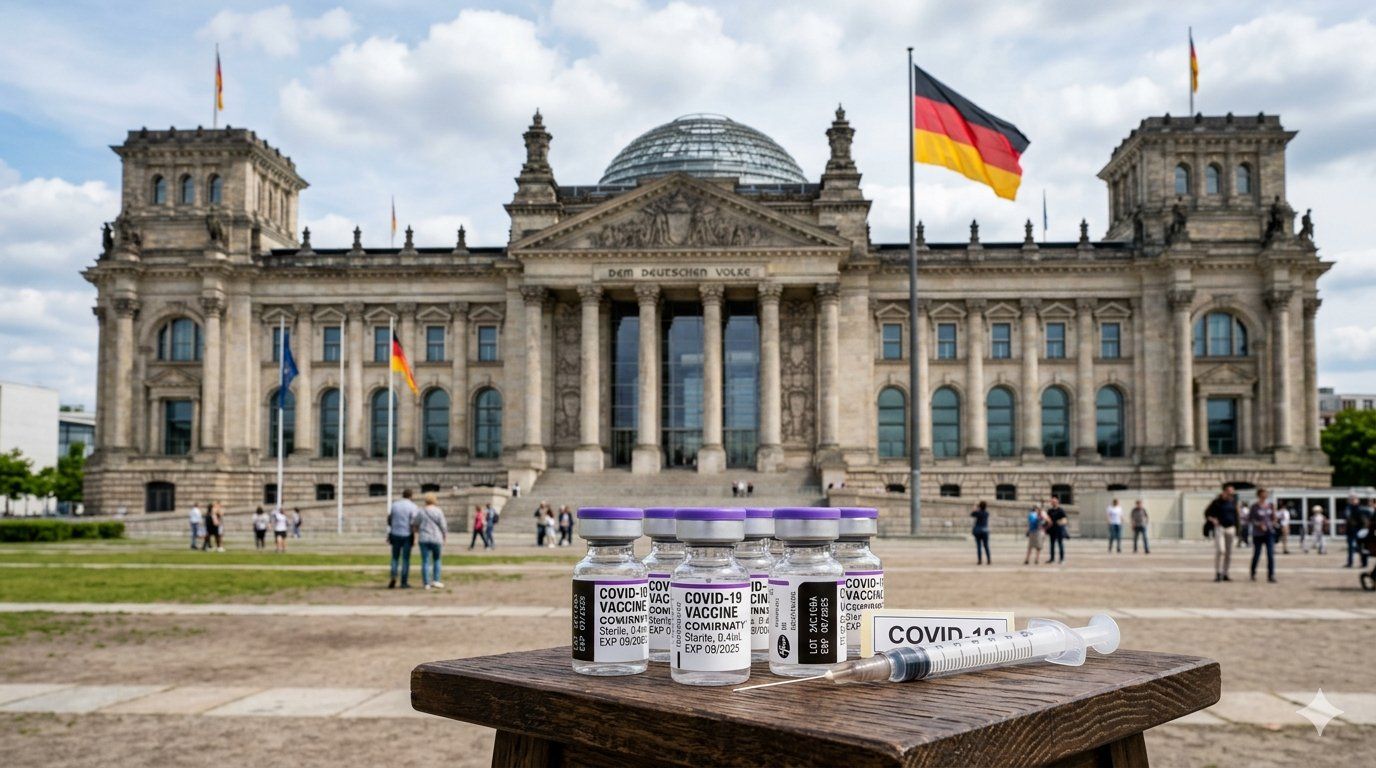
In Germany, parliamentary reckoning with the period of the COVID-19 pandemic is underway. This concerns the work of the Bundestag's Enquete-Kommission, which is to assess the course of the pandemic and prepare recommendations for the future. The commission's final report is to be presented by the end of June 2027. During a high-profile hearing on March 19, 2026, those who appeared included Dr. Helmut Sterz, described in Bundestag documents as a toxicologist and former chief toxicologist of Pfizer. In its official summary, the Bundestag noted that Sterz very sharply criticized the vaccination strategy, while former Health Minister Karl Lauterbach replied that the safety of vaccinations had been well studied and that they had not led to excess mortality.
This is exactly how the dispute is described by Aleksandra Fedorska, editor-in-chief of the Radio Debata Press Agency. In her assessment, after years Germans are returning to a topic that from the outset has had an exceptionally large political and social weight in this country. Her interlocutor emphasizes that the restrictions east of the Oder were longer and harsher than in Poland, and the entire society strongly felt the effects of that policy.
Aleksandra Fedorska draws attention to the fact that the very establishment of the commission is an important signal, even if - in her opinion - it comes late. According to the official Bundestag description, the commission is to deal not only with public health but also with the economy, education, social policy, and public communication. This means that the pandemic is to be assessed more broadly than just through the prism of medical decisions.
The interlocutor, however, does not hide skepticism about the effects of this process. "In my opinion, from my perspective, the work of this investigative commission is a sham reckoning. A sham," she says. And she adds that, in her opinion, it is "very probable" that none of the most important politicians will bear more serious consequences.
One of the reasons for which the topic resounded again more strongly is a fragment of the March hearing with the participation of Helmut Sterz. In Bundestag documents he appears as an expert invited to the session of March 19, 2026, and the official summary records that as the former chief toxicologist of Pfizer, he criticized the studies and approval of mRNA vaccines, even speaking of a "vaccination tragedy" and "millions of victims."
Fedorska recalls that enormous emotions grew around his statements, especially after fragments of the recording spread. In the conversation, however, she also emphasizes that Sterz is a strongly controversial figure who has long functioned in circles critical of vaccinations. "Helmut Sterz is known in this scene of anti-vaxxers, so it is easy to discredit his statements, to link them, for example, with some conspiracy theories," she says.
This is an important reservation, because the very figure of "60,000 dead," referred to in the conversation, remains a thesis attributed to Sterz, not a finding of the commission. The Bundestag in its official summary noted his sharp criticism, but at the same time cited Lauterbach's completely different assessment.
In the same debate, the position of former Health Minister Karl Lauterbach resonated strongly. The Bundestag summarizes it clearly: Lauterbach said that according to the WHO the pandemic claimed about 15 million victims worldwide, and the scientific consensus says that thanks to vaccinations this number was not even higher. He also emphasized that vaccinations did not cause excess mortality and that their safety has been well studied.
Fedorska notes that it is precisely voices such as Lauterbach or the former head of the Robert Koch Institute Lothar Wieler that are followed much more attentively in Germany than the statements of Sterz. "Germans rather focus on what the health minister says," she says, indicating that throughout the years of the pandemic it was precisely these politicians and officials who were for many citizens the most important authorities on COVID-19 matters.
In her account, both maintain that Germany got through the pandemic relatively well. This position coincides with the official record of the hearing, where Lauterbach said that the country "got through the pandemic relatively well," although he also admitted the existence of rare complications, such as myocarditis or thrombosis.
The interlocutor draws attention to the fact that in the German debate the topic of the social effects of the restrictions, particularly for children and youth, is increasingly clearly returning. And here too she finds support in the work of the commission: the Bundestag indicates that the analysis of the pandemic encompasses, among others, the areas of education and social consequences of the crisis.
Fedorska speaks about this very clearly. "What I have not noticed and what in my opinion is underestimated within the work of this commission, which focuses on issues of medicine, on social issues, is in my opinion the economic element," she assesses. Earlier she also emphasizes that it was precisely children and youth who bore some of the most difficult consequences of isolation, restrictions, and the closure of social life.
In her opinion, this is no longer just about old emotions, but about real effects, which in Germany are visible to this day. She speaks of problems of reintegration, weakening of social bonds, and a long-term psychological crisis, which in her assessment has been treated too weakly in the public debate.
Aleksandra Fedorska also strongly emphasizes the economic thread. In her assessment it is here that the largest gap in Germany's reckoning with the pandemic is visible. The commission is also to investigate the economic effects of the crisis, but the interlocutor believes that this element does not resonate strongly enough. The Bundestag itself announces that the commission's work is to also include the economy and the resilience of society to future crises.
"Germans have to this day not emerged from this cyclical slump," Fedorska says. She adds that the effects of great subsidies, grants, and the switching of the state into crisis mode are visible to this day, and in her opinion it is precisely these financial consequences that should be the subject of a much more detailed analysis.
At the end of the conversation, the political thread returns, namely the relationship between criticism of pandemic restrictions and the rise of significance of AfD. Fedorska has no doubt that it is precisely this party that from the outset most strongly undermined both the restrictions and the vaccinations, and today is trying to politically benefit from the growing disappointment of part of German society.
"AfD has greatly gained through these COVID years," she says. In her opinion, it is precisely because of this context that figures such as Sterz are automatically placed in the same line as a sharper, anti-system political message. This in turn affects the way their statements are perceived in the media and in the mainstream of debate.
At the same time, the interlocutor emphasizes that, regardless of party disputes, the very question of whether Germany will really settle accounts with its pandemic balance still remains open.
Here the schedule is clear. The Bundestag officially announces that the comprehensive final report of the commission is to be presented by the end of June 2027 and is to contain concrete recommendations for the future. The commission operates in the formula of 14 deputies and 14 outside experts.
Fedorska, however, does not believe that the report itself will change the political memory of the pandemic. In her opinion, it will most likely end with sharp statements, interpretive disputes, and a partial correction of the narrative, but without a real revaluation of the responsibility of the most important decision-makers.