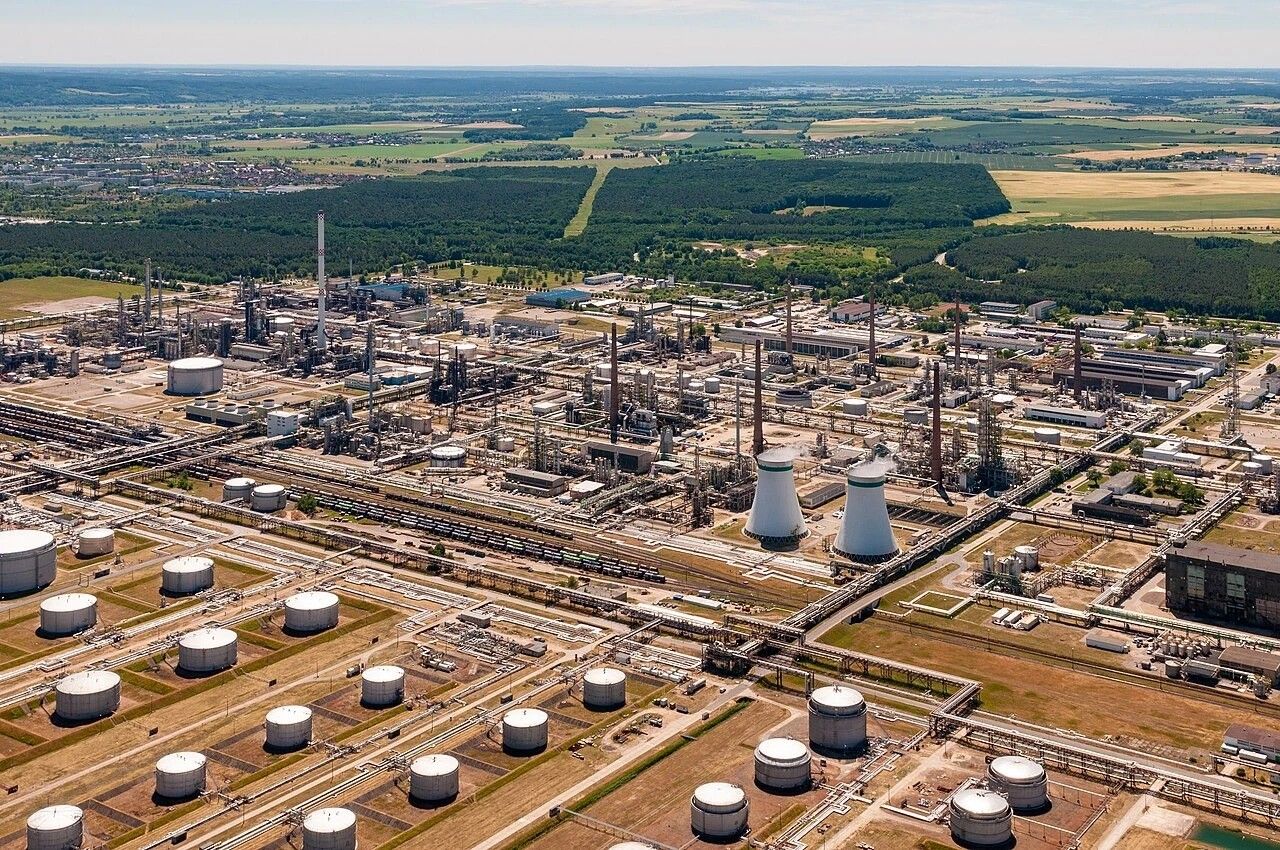
Starting 1 May 2026, the PCK Schwedt refinery enters its most serious supply crisis since Russia's invasion of Ukraine. Moscow's decision to halt all oil transit through the northern branch of the Drużba (Friendship) pipeline strips the plant of 20-25 percent of its processing capacity - roughly 130-150,000 thousand tonnes of crude per month. This is a historic opportunity for Poland.
The refinery, located just 10 km from the Polish border, supplies around 90 percent of the fuel needs of Berlin, Brandenburg and parts of Mecklenburg-Vorpommern, while simultaneously serving as the key jet-fuel provider for Berlin Brandenburg (BER) airport. Given annual jet-fuel volumes in the hundreds of thousands of tonnes (including an estimated 450,000 litres for the capital's hub), even a short-term production cut can trigger real shortages, price hikes and pressure on aviation logistics across the entire region.
Germany has been backed into a corner. After years of manoeuvring over de-Russification - because Russia's Rosneft still formally controls 54 percent of the shares, placed under trusteeship in 2022 - Berlin is now paying the price for its dependence on Russian oil.
Brandenburg's Premier Dietmar Woidke (SPD) continues to describe Russia as a "trusted partner", and Economy Minister Katherina Reiche (CDU) offers reassurances that "production will continue". The reality, however, is brutal: the refinery could fall to 55-60 percent of its processing capacity, directly threatening supplies to Berlin. The first political reactions are already emerging - Die Linke MP Christian Görke is openly demanding a ban on private jet flights and short-haul connections under 500 km, arguing that rail should be promoted instead. This is not an abstract climate debate. It is a symptom of panic in the face of a real risk of interruptions in the jet-fuel supply chain serving one of Germany's most important airports.
Against this backdrop, Poland is moving to the forefront - and not as a passive observer, but as a strategic player. Berlin's federal government has announced urgent talks with Warsaw on boosting oil deliveries through the Naftoport terminal in Gdańsk and the Polish pipeline network operated by PERN. The Polish company has already, almost obsequiously, declared readiness to pump additional volumes.
The crisis lays bare a deeper dimension of Polish-German energy relations. Schwedt has for years been not only a refinery, but a symbol of delayed de-Russification and cross-border tensions. Germany's dirtiest fuel plant has repeatedly exceeded SO₂ and NOₓ emission limits, and the pollution does not stop at the Oder - residents of Słubice, Gubin and Kostrzyn have been reporting tangible effects for years. At the same time, the refinery also supplies western Poland. For years, Berlin rejected serious proposals to bring Polish capital (PKN Orlen, Unimot) into the refinery, deeming "dependence on Poland" politically unacceptable - while in reality maintaining dependence on the Kremlin. Today, as Russia deliberately turns off the tap, the Germans themselves are asking for help.
The window of opportunity is narrow. If Warsaw uses the crisis to move on the German jet-fuel market with a clear strategic objective, it will cement Poland's position as a key player in Central European energy. If, however, it falls back into the old patterns of concessions, it will miss a chance that history only offers once a decade.