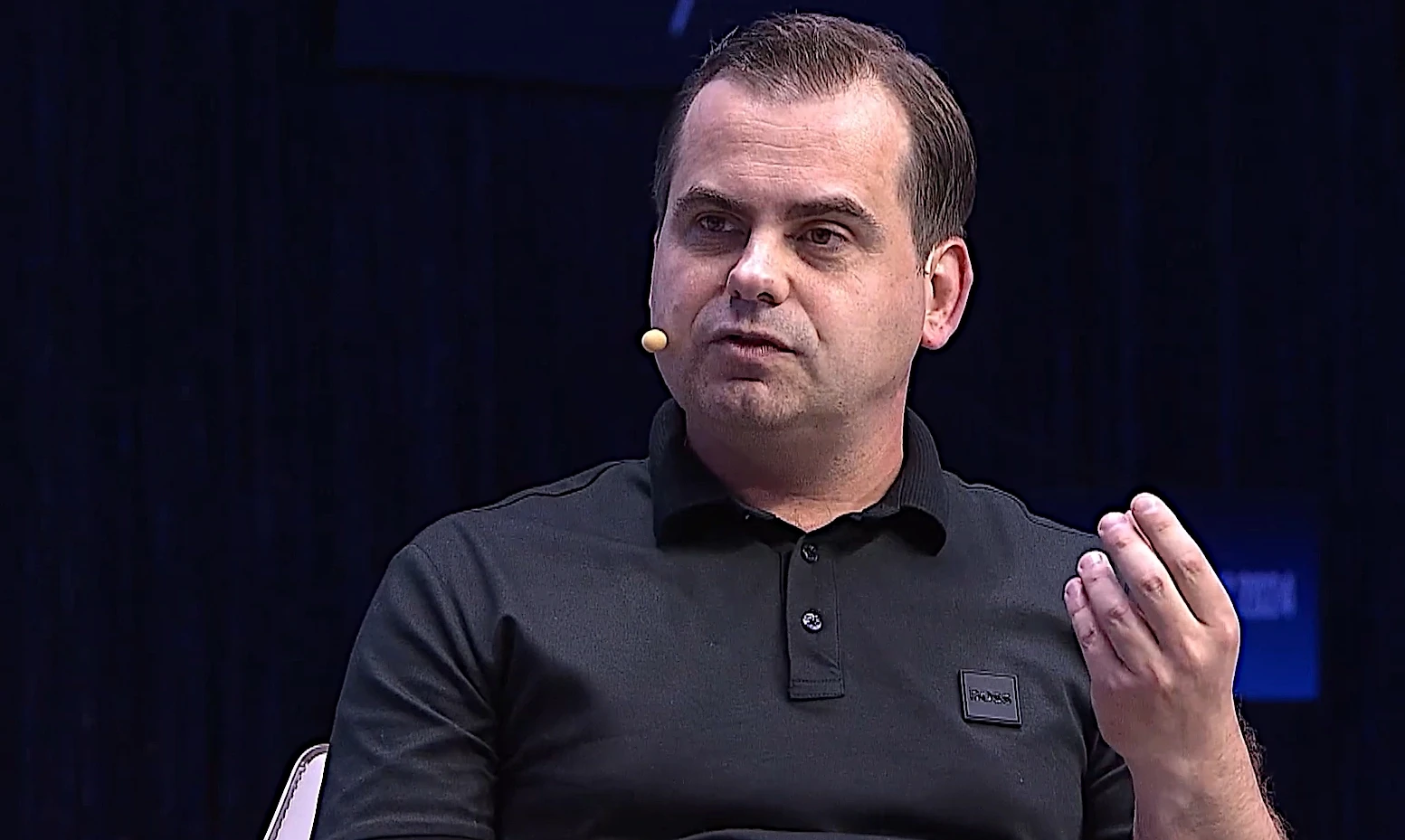
DeepL, one of the hopes of European artificial intelligence, has for years won admiration around the world. Formally a German company from Cologne, specializing in translations based on neural networks, it regularly outperforms the giant Google Translate in terms of quality and naturalness of translation. Founder and CEO Jaroslaw Kutylowski is now being criticized in Germany for the "Americanization" of the company.
A Pole born in 1983, he has become a symbol of cross-border success: from coding as a child in Poland, through a doctorate in computer science in Germany, to creating a global unicorn (a startup that has exceeded a value of one billion dollars - editor's note) worth billions of dollars. Until recently, DeepL appeared as an example of "Rhenish calm" combined with German precision and Polish determination. Today, however, the company finds itself at the center of controversy. German employees tell German media about their Polish boss's collaboration with American managers, the introduction of a Silicon Valley-style work culture, and preparations for an initial public offering on a US stock exchange.
Jaroslaw Kutylowski is a figure who could be the hero of a book about the success of Polish business in the German technology sector. Born in Poland in 1983, he started coding as a ten-year-old. He studied computer science, specializing in mathematics and machine learning. He defended his doctorate in computer science. Before DeepL, he worked as Chief Technology Officer at Linguee, a translation search service founded in 2007 by Gereon Frahling. Linguee became the key foundation for DeepL. In 2017, Kutylowski transformed the company into DeepL, using Linguee's huge database to train advanced neural networks. "Be bold, move fast" - this is his motto, which from the very beginning has accompanied his vision of creating not just a translation tool, but a global AI leader.
DeepL started modestly in Cologne-Ehrenfeld, but quickly gained global recognition. Already in the first tests it instantly outperformed the competition. The translations were more natural, contextual, and less "robotic" than those offered by Google or Microsoft. The company grew rapidly. In 2023, it reached unicorn status with a valuation of one billion dollars. In mid-2024, it raised 320 million dollars in a financing round led by American venture capital funds (high-risk capital funds invested in innovative young companies (startups) with high growth potential, in exchange for shares - editor's note) - Index Ventures and IVP - which boosted the valuation to two billion dollars. Investors such as Benchmark, IVP, and Index Ventures saw in DeepL a European answer to ChatGPT and other generative AI tools. Today the company employs more than 1,000 people, with some estimates as high as 1,500, and offers not only DeepL Translate, but also DeepL Pro for businesses, DeepL Write (a writing assistant), voice translations, and experimental AI agents. Their clients include, for example, Deutsche Bahn, universities, corporations, and public institutions. DeepL has become an indispensable tool in global communication, particularly in sectors that demand precision - legal, medical, and technical.
On paper, the financial success looks impressive. In 2022 revenues amounted to about 54 million euros, almost double the previous year. Internal forecasts from November 2024 envisage growth to almost 338 million euros by the end of 2026. However, behind these figures lies the other side of the coin, which the newspaper "Handelsblatt" described. The company plans to operate at a negative operating result (EBIT) until at least 2027. This means consciously accepting multimillion-dollar losses for years to come in the name of aggressive investment in development and scaling. What is more, since 2022 DeepL has not published the legally required balance sheets for 2023 and 2024, which raises questions about transparency. Creditreform points out that the company is not fulfilling its disclosure obligation. The internal financial plan also envisages a sharp jump in "Total Cash Flow" in 2026, the sources of which are not transparent.
"DeepL is reportedly planning a stock market debut. However, an investigation conducted by Handelsblatt reveals questionable financial forecasts and internal cultural conflicts. Does the startup have a future?" - writes Jan Lutz in the article "Doubtful business data of candidates for a position in the field of artificial intelligence in Germany."
It is precisely these financial and strategic plans that have become the source of conflict. According to reports by "Handelsblatt" and "Trading-house.net", DeepL is actively preparing for a stock market debut. Most likely on the American stock exchange in 2026, with a potential valuation of as much as five billion dollars - according to Bloomberg. To prepare the company for entry to Wall Street, in 2025 the company took out a large "Senior Term Loan" (a senior term loan - editor's note) in the amount of 75 million dollars. The change at the CFO position was crucial: German manager Markus Harder was replaced because, as sources in business circles claim, he lacked experience in stock-market procedures and US GAAP standards (Generally Accepted Accounting Principles - a set of fundamental accounting standards, principles, and procedures used in the United States - editor's note). The position is temporarily held by Briton Peter McDougall, who previously took part in the stock market debut of the American company Sprinklr in New York. This is not the only change. From mid-2023, managers with experience at American giants have been joining the management board: David Parry-Jones (former Chief Revenue Officer, previously at Microsoft and Salesforce), Sally Sourbron (Chief People Officer), and Helen Wey (responsible for finance, with experience at Goldman Sachs, Microsoft, and Salesforce).
It is precisely this "Americanization" of management that has become the main reason for criticism. The company's former German corporate culture has been replaced by an American operating model. Germans describe this as the end of "the nice DeepL." On the Kununu platform, anonymous opinions are appearing: "Silicon-Valley-Bros are destroying the culture and values that once made the company a good place to work." Former sales employees speak of constant pressure for results and "presenting the numbers" for investors. Top performers are rewarded with exclusive trips, which causes internal disputes, especially in the context of the German model with the works council (Betriebsrat). One former manager said bluntly: "People feel cheated." Internal employee surveys turned out catastrophically for the management team, although DeepL rejects these results as "one-sided."
According to "Handelsblatt", in the second half of 2024 there were serious disputes between German and Anglo-American financial experts - differences in metrics (revenues, cash flow, EBIT) reportedly led to a "slaughter" at the second level of financial management. American managers introduced harsh internal competition, typical of Silicon Valley but alien to many German specialists accustomed to a more balanced approach. Kutylowski defends these changes. He claims that "new staff and new structures are typical for fast-growing startups." He emphasizes that employee turnover is conducted "very comfortably below the industry average," and that the company still has a chance for "Germany and Europe to play a leading role in the field of AI." "It is not yet too late" - he repeats.
However, critics believe that this is a fundamental paradigm shift: from the European model based on quality and long-term development to the American "grow or die" model, dominated by the expectations of Wall Street investors. The plans for an IPO (Initial Public Offering - the process by which a private company first offers its shares to a wide range of investors and debuts on the stock exchange in the USA - editor's note) require adaptation to local reporting standards, aggressive marketing, and the constant demonstration of growth, even at the expense of current profitability. Golem.de confirms that DeepL is consciously planning losses for many years, which is a strategy typical of American technology companies but raises doubts in the German regulatory and cultural context.
The future of the company remains open. Bloomberg reported at the end of 2025 about a possible IPO in 2026. Alternatives include a sale to a strategic player from Silicon Valley or to private equity (private capital - a form of investment in which funds invest in private companies not listed on the stock exchange - editor's note). Internal tensions show how difficult the road is from a startup to a global leader in a competitive market. The Polish founder, who once symbolized transatlantic success, is today accused of going too far in aligning with the American business model.
[Author Aleksandra Fedorska is a journalist for Tysol.pl and numerous Polish and German media outlets]
[Title, lead, the "What You Need to Know" and "What This Means for the Development of the AI Sector in Europe" sections, as well as some subheadings, were added by the editorial team]
Who is Jaroslaw Kutylowski? He is a Polish computer scientist and entrepreneur, founder and CEO of DeepL - one of the most advanced companies dealing with translations based on artificial intelligence.
What is DeepL and why is it important? DeepL is a translation tool using neural networks, considered one of the most accurate in the world. The company is often cited as a European competitor to global technology giants.