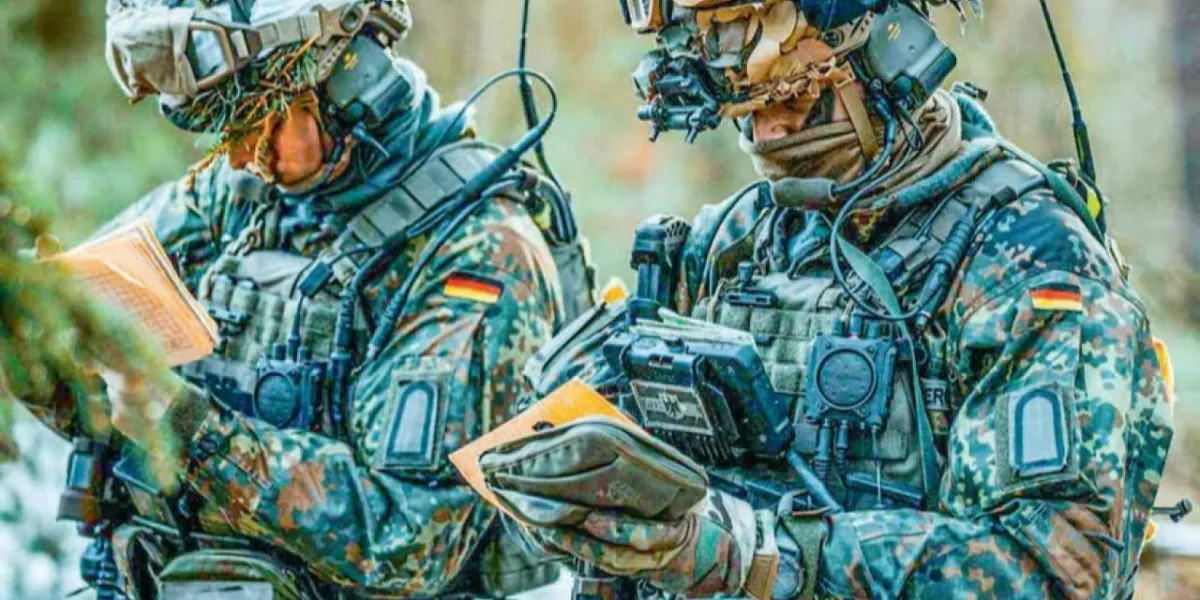
Germany conducted a readiness test of its Bundeswehr brigade in Lithuania. The method has its roots in the Prussian war game of the 19th century, which used topographic maps and game elements to practice military strategy.
A modern "war game" is a simulation and training method that models strategic, operational, or tactical scenarios to train decision-making, planning, and leadership skills.
Armored Brigade 45, stationed in Lithuania under German command, is to achieve full combat capability by the end of 2027 according to the German Ministry of Defense, in line with the schedule agreed between Berlin and Vilnius.
A key element is the mobile command headquarters - the brigade's "brain," which must be fully operational, staffed with the right personnel, equipped with secure communications technology, and running processes compliant with NATO standards. However, the war game conducted by the Bundeswehr revealed a number of weaknesses that require urgent change.
In the event of a Russian attack on Lithuania, the brigade must be able to cooperate seamlessly with other NATO member states. As Colonel Thomas Zimmermann, deputy head of the operational readiness department at the Ministry of Defense, told the German outlet Table.Media:
The war game showed that current command processes are effective, largely thanks to experience gained from the multinational battlegroup in Lithuania since 2017 under "enhanced Forward Presence." However, language barriers remain a problem - many soldiers have difficulty communicating fluently in English, which forced them to switch to German during the simulation.
One of the most serious problems is the excessively large "electromagnetic footprint" of the brigade's IT systems. Russian signals intelligence, effective thanks to jamming and signal-spoofing techniques, can easily locate every radio transmitter, satellite link, or directional antenna.
"The current [electronic] equipment makes us an easy target for Russian artillery,"
warns Zimmermann in an interview with Table Media. The solution is to increase the distance between transmitters and the headquarters, use cables instead of radio links where possible, and employ harder-to-detect forms of transmission. The war game, which simulated adversary actions based on lessons from the war in Ukraine, demonstrated that these changes are urgently needed.
IT support processes that were effective in Afghanistan also failed the test in Lithuania. The model used there, based on trouble tickets and lengthy procedures, does not work in wartime conditions against Russia, where a commander must make rapid, autonomous decisions on the battlefield. The German brigade's IT systems require simplification and autonomy.
Another challenge is the divergence in security classification standards. The German classification system (e.g., "VS-NfD" - for official use only) is not compatible with the Lithuanian system, which distinguishes only between "public" and "secret." Documents classified as restricted in Germany must be elevated to "NATO Secret" for communication within the Alliance, generating additional administrative effort and raising the risk of detection.
For Germany, the key question, according to Zimmermann, is: where should the command headquarters be located in the event of war? Germany is even considering moving the division headquarters - the unit superior to the brigade - outside Lithuania, for instance to Poland or Germany.
The German brigade is still awaiting key equipment and personnel, including armored GTK Boxer command vehicles with digital radios, which are due to arrive in the coming weeks. By year's end, approximately 500 soldiers are to be stationed in Lithuania, but the full relocation of two armored battalions from Germany is planned only for 2026, on the condition that the necessary infrastructure - barracks and training grounds being built by the Lithuanian side - is ready. The war game confirmed that current equipment procurement orders must be reviewed to ensure the brigade's full combat capability. "The time for changes in the procurement process is running out," Zimmermann notes.