In public debate the Central Communication Port (CPK) gets endlessly framed as an airport, while its single most important element is talked about as if it were a toy for railway enthusiasts or just another bar on a chart in some pre-election bidding war. Yet it is precisely the railway component that directly determines the security of the state - far more than the airport itself. And it is precisely this component that is being dismantled before our eyes.
Not the airport, but the railway.
The CPK railway programme in its 2017 shape means more than two thousand kilometres of new lines - the first such comprehensive plan in decades to build a coherent rail network in Poland. It was not just about delivering passengers to the airport. It was about connecting Poland with Poland, about closing those connections that, for historical reasons, were never built here, because when nineteenth-century Europe was laying down its railway backbone, Poland simply was not on the map. Out of that grand plan, the authorities in practice kept only the so-called "Y line" - the Warsaw-Łódź-Poznań-Wrocław route - and the entire rest, those less populous, "solidarity" directions, they simply threw out. And let no one try to convince me that it was about savings, because the cost of the documentation alone is a fraction of the cost of construction. It was about something else entirely.
On the battlefield it is the timetable that wins.
And here we come to the matter that is most important to me, namely security. There is a saying, often attributed to generals, that in war amateurs look at tactics, while professionals look at logistics. Soldiers fight and die, but in the final reckoning a war is won by the timetable and the locomotive. This is not a poetic metaphor. Already in the mid-19th century Helmuth von Moltke the Elder argued that, for the defence of the country, it is better to spend millions on completing the railways than on new fortresses - and he proved it in 1866 at Königgrätz (Sadowa), when he threw five railway lines against the Austrians at once, while the enemy had only one. That is exactly how wars are won.
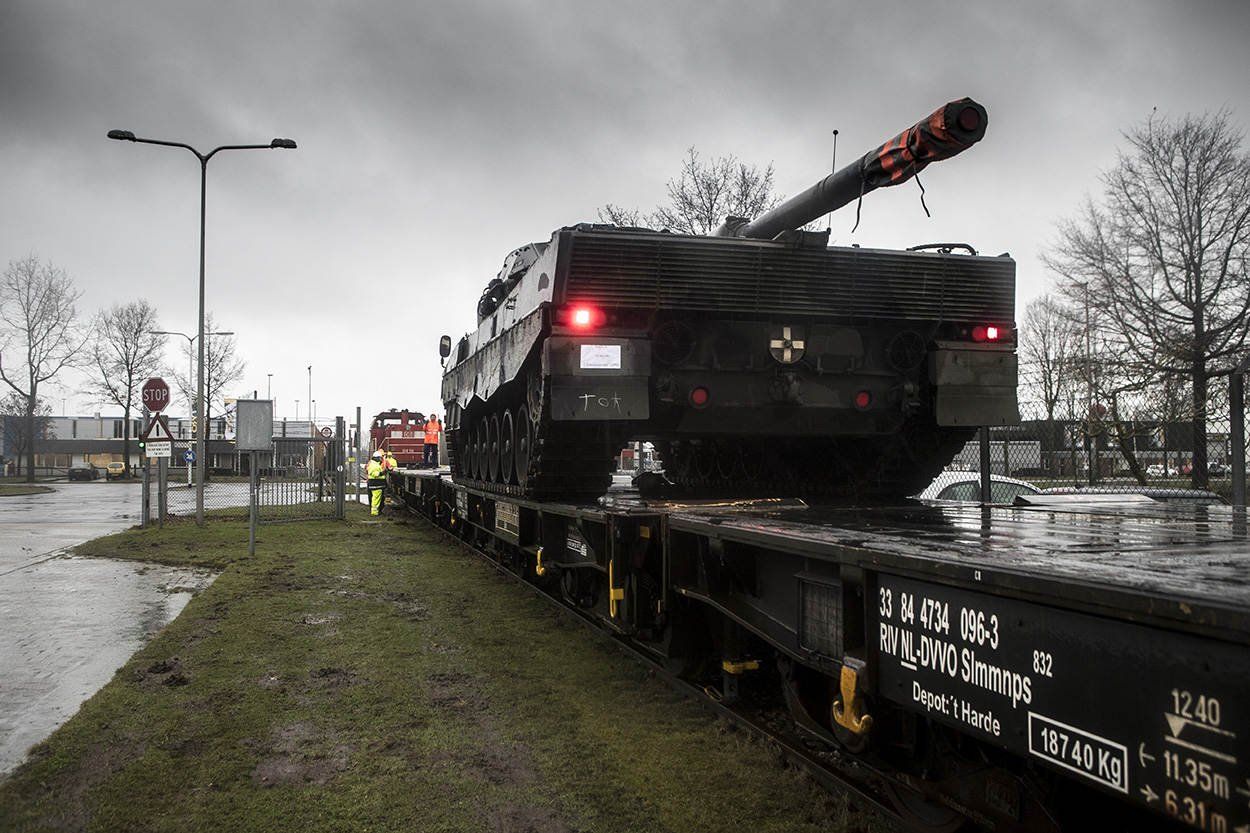
Let us translate this to our situation. A single armoured brigade means more than four thousand soldiers, hundreds of tanks and vehicles - moving it requires hundreds of railway wagons. And by road? That means columns of oversized loads stretching for tens, and in a larger operation hundreds, of kilometres; each such load heavier than a hundred tonnes and wider than three metres, the kind that not just any bridge can bear and that has to be guided with a pilot vehicle. Meanwhile, in line with NATO commitments - after the Madrid summit the alliance tripled its high-readiness forces and set their movement to the eastern flank in weeks, not months - we are talking not about one brigade, but about enormous masses of troops. Without a dense, double-track rail network, any attempt at such a transfer means the paralysis of the entire country. This is not fantasy, it is pure arithmetic.
And now let us look at the map. To the Suwałki Gap - that narrow chokepoint between Kaliningrad Oblast and Belarus, which General Ben Hodges called the place where all of NATO's weaknesses converge - there leads, in practice, a single railway line. Rail Baltica, our gateway to the Baltic states, is in its first stage being built as single-track, and on a single track we will push through barely a dozen or so trains a day, while in the hour of trial many times more will be needed. And it is precisely these military directions - such as the Mazurian spoke from Ostrołęka through Łomża to Giżycko - that, instead of construction getting under way, have been sent back for redesign, and every such "reset" means years lost. That is why I say without mincing words: today these lines are more important than whether we reach Poznań a quarter of an hour faster.
I say this as an old port man, because the second dimension is the ports, and about this I do happen to know a thing or two, because it is my former world. Our four large ports - Gdańsk, Gdynia, Szczecin and Świnoujście - lie at the two ends of the coast, almost three hundred kilometres apart in a straight line. Between them stretches Middle Pomerania, the longest stretch of the Polish Baltic coast without a large port and without a proper access route - a textbook case of whole regions cut off from transport. On top of that comes the purely military dimension: our main naval base in Gdynia lies right next to Kaliningrad Oblast, and to the second base, in Świnoujście, a proper road connection was only opened in 2023. A serious state does not leave such blank spots on its own map.
A game that must not be played here.
So I ask plainly: in the name of what was all this halted? Because it is hard to resist the impression that the communications backbone crucial to our security has become a hostage to party games - that someone, just to set themselves apart from their predecessors, is ready to gamble with the very physical existence of the nation. One can argue about whether this is still ordinary negligence, or already something that tempts one to call it sabotage; I do not throw that word around lightly - but the question itself is entirely legitimate. Because there are areas of the state on which internal squabbles should never set foot, and defence is the first of them. The government assures us that it has abandoned nothing, that it is building a new, "integrated" rail network - fine, I take them at their word and will hold them to account on the deadlines, because politics is not wishes but concrete kilometres and concrete dates. Only a year is left until the elections. Draw your own conclusions.
With a cool head
With a cool head, the whole matter comes down to a single question - whether, in the hour of trial, we will be able to move an army across our own state, our own and our allies'. Because if not, then no declarations from allies will be worth the paper they are written on; a partner has every right to say: "if you cannot even transport us, then we are not coming." The railway is not a toy for enthusiasts and not a bar in an opinion poll. It is a tool with which war can be prevented altogether - and preventing it is by far the cheapest option. Let us build this backbone while we still have time, because Russia will not wait for us to wake up.
In this text I draw on the assumptions of the 2017 CPK railway programme and its later changes, on the documents of the trans-European transport network TEN-T and the Rail Baltica project, on NATO's decisions regarding the force model after the Madrid summit in 2022, on public analyses concerning the Suwałki Gap and Polish ports, as well as on historical facts regarding the role of railways in the wars of the 19th and 20th centuries.