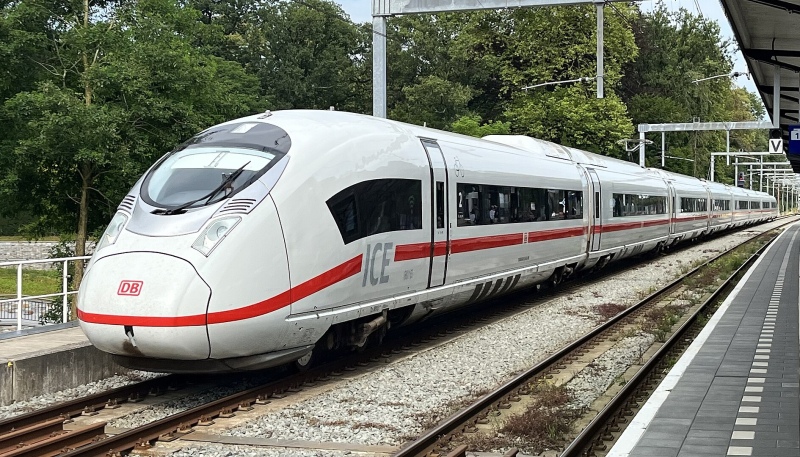
Germany's long-distance rail network ICE, dominated by Deutsche Bahn (DB), may soon become an arena of fierce rivalry with Italian competitors. Two Italian companies — state-owned Trenitalia and private Italo — are planning to enter the high-speed rail market in Germany. The move promises billions in investment, more frequent services, and thousands of new jobs in Germany.
The ambitious plans of the Italian operators came to light following a report in the Frankfurter Allgemeine Zeitung (FAZ). Italo has already established a wholly owned subsidiary in Germany and filed an application for a railway operating license in October. Italo intends to invest approximately one billion euros in 30 to 40 high-speed trains and operate domestic services within Germany. "This is a step toward greater competition, which could lower prices and improve service," FAZ comments, pointing to the successful Italian model.
Italo, known for its red trains racing at 300 km/h, sees Germany as a lucrative market. Currently, DB controls 95 percent of the long-distance segment, with only a few exceptions such as the private operator Flixtrain. However, the Italian operator is demanding 15-year framework agreements from the German government for track access in order to plan investments securely. The decision rests with the Bundesnetzagentur and policymakers. This is where the plans could stall. Italo's headquarters in Rome have declined to comment on details, but industry sources suggest that the first services could run on the Berlin-Munich or Hamburg-Frankfurt routes.
For passengers, this represents a chance for a genuine alternative. In Italy, Italo and Trenitalia split the market roughly equally — ever since 2012, when liberalization opened the door to competition. The effect has been positive. Ticket prices dropped by as much as 20 percent, more services were launched, and punctuality improved. "This could work in Germany too," FAZ emphasizes. Italo is planning not only domestic routes but also the expansion of international services, such as from Milan to Munich.
In parallel, the state-owned Ferrovie dello Stato (FS) with Trenitalia is also planning expansion in Germany. The company is considering the purchase of 50 high-speed trains for the German market. Trenitalia already has a presence in Germany through its subsidiary Netinera, which manages regional services, while TX Logistik handles freight transport. CEO Stefano Donnarumma makes no secret of his enthusiasm: "We are very pleased that the new head of DB is an Italian, Evelyn Palla." It is a subtle nod toward Berlin, where an Italian manager has recently taken charge.
Trenitalia, with its Frecciarossa fleet, sees potential in integrating with the existing network. Plans include "preliminary market studies," as FAZ reveals, with an emphasis on profitable routes. Investments could reach several billion euros, creating thousands of new jobs. "Germany is an important market," Donnarumma adds, signaling that decisions will be made soon.
DB, plagued by chronic delays and billions in losses, is losing ground. In 2024, only 65 percent of ICE trains arrived on time, and passengers complain about high prices and rolling stock problems. Competition from the south could create more options and better quality.
However, challenges remain. German infrastructure is outdated: tracks are not always suitable for trains traveling at 300 km/h, and bureaucracy slows down licensing. The Bundesnetzagentur must balance competing interests — providing network access without favoring DB. Politicians, including the Greens and the SPD, support liberalization, but the rail lobby warns of "chaos." "This is a chance for rail passengers to breathe," FAZ concludes, seeing in it "light at the end of the tunnel."
The entry of Italo and Trenitalia into the German market aligns with the EU's open rail market policy. Directive 2012/34/EU mandates open access to tracks, which succeeded in Italy, where the market grew by 30 percent. Germany, with its dense rail network, could follow suit and emulate Italy — especially after the pandemic, when passenger traffic rose by 15 percent.
For German environmentalists, more trains mean fewer cars and planes. Meanwhile, economists estimate that competition on German tracks will drive prices down by 10 to 15 percent, attracting millions of new passengers. Will the Italian duo break the German monopoly? Plans are advanced but not yet final. Passengers wait with hope — for cheaper tickets and less frustration. As Business Insider comments: "German rail transport may soon become more colorful and competitive."