Kosiniak today is like Bosak in 2020.
The parliamentary elections were yet another clash between PiS and PO — between Jaroslaw Kaczynski and Donald Tusk. Both of the largest parties received results roughly in line with what the polls had predicted, though Law and Justice certainly fell below expectations. It seems, however, that this time the decisive factor in the final balance of power in the Sejm was the battle for "the bronze medal" playing out in the background. Two coalition formations competed for the title of "the third one" — the force that would collect the votes of Poles tired of polarization and the PO-PiS duopoly, often people without strong or well-defined ideological convictions.
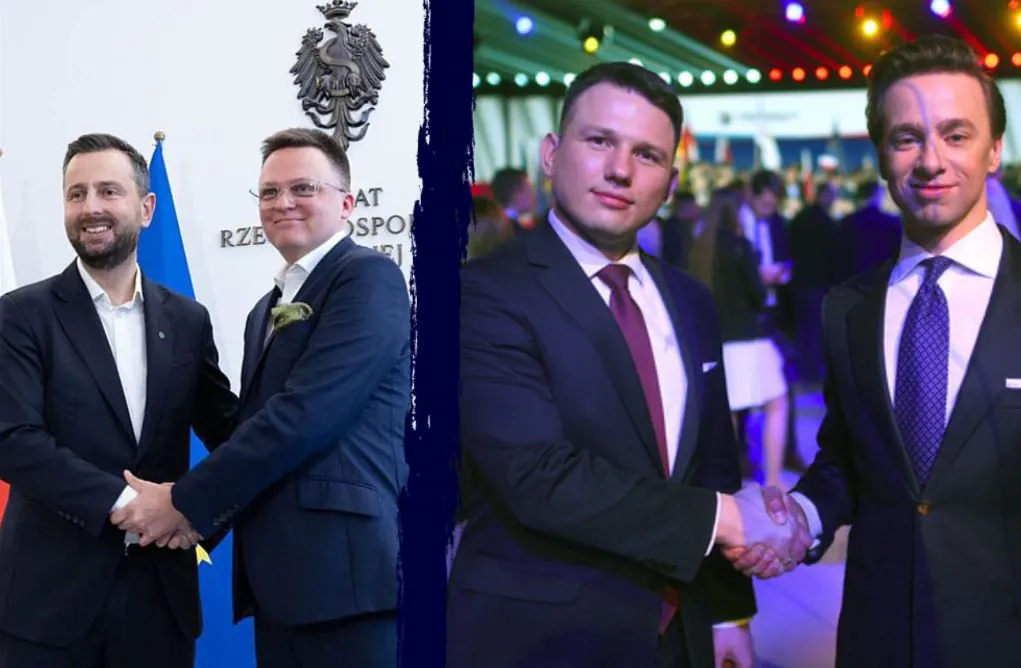
The juxtaposition of the Third Way and Confederation may seem eccentric at first glance — these are political forces from entirely different worlds, with completely different histories and initial public perceptions. In practice, the parallels are genuinely numerous. In both cases we have coalitions of many different circles and "free electrons" floating (to simplify) to the notional right of PiS or between PiS and PO. In both cases we have dual leaderships — Krzysztof Bosak and Slawomir Mentzen versus Wladyslaw Kosiniak-Kamysz and Szymon Holownia. In both cases the fundamental slogan is breaking with the duopoly and "introducing new quality into politics," and the impression intended to be conveyed is one of freshness. Confederation repeated the slogan of "overturning the table"; in the case of the Third Way, the name speaks for itself.
Both formations wanted to play on depolarization and fatigue with the two forces that have dominated Polish politics for two decades. And both had a chance to achieve an excellent result in these elections. Confederation's poll numbers rose almost continuously throughout the first half of the year. In July I wrote that the Bosak-Mentzen alliance had a chance to achieve the best result of any formation other than PiS or PO since 2005 and the beginning of the current era in Polish politics. The previous record — 13.15 percent for the Left and Democrats in 2007 — was indeed broken. But it was the Third Way that accomplished this, securing 14.4 percent. For several months, the Third Way's entry into the Sejm had been in doubt given the 8 percent threshold. Some polls gave them around 7 percent. In the end, Kosiniak and Holownia received a result nearly twice the threshold. It was Confederation that dropped from the 13-15 percent level to 7 percent. The two committees effectively swapped places. Neither PiS, nor KO, nor the Left recorded fluctuations of this magnitude in recent months. This further supports the thesis that it was along this axis that voters were moving.
Moreover, it was precisely the Third Way's result that proved decisive for the composition of the Sejm. For a long time it appeared that "the third" player calling the shots would be Confederation, without whose support neither PiS nor the center-left bloc would have a majority. Now it turns out that the Third Way has taken that place — without it, no majority can be formed, neither center-right, centrist, nor center-left.
For the moment, the great players are courting Wladyslaw Kosiniak-Kamysz, just as they courted Confederation and Krzysztof Bosak between the first and second rounds of the presidential election. Suddenly everyone turns out to be an admirer of the agrarian movement's traditions, just as three years ago they discovered within themselves a fondness for the Independence March, the legacy of national democracy, and the free market.
History moves in circles — back then, Kosiniak fell from 17 percent in the polls to a final result of barely 2 percent. Building a lasting "third force" in Polish politics is decidedly not an easy task; nothing is given forever, and current results by no means have to be repeated in one, two, or four years. Already during the aforementioned previous election cycle, substantial flows along this axis were visible — several hundred thousand of Confederation's October 2019 Sejm voters supported Szymon Holownia for president a few months later. At the same time, Krzysztof Bosak made up for those losses by attracting some PiS voters and non-voters. In the most recent elections as well, it was the Third Way that, according to exit polls, attracted the greatest share of 2019 Confederation supporters who did not back it this time — 11.1 percent.
READ ALSO: Landscape After the Battle. Why Did PiS Lose?
Two Percentage Points That Tipped the Scales
The decisive significance of the TD-Confederation junction is shown by the numbers. Kosiniak and Holownia managed to reach a level at which the d'Hondt method — which favors large parties — stops working against them: they received 14 percent of the vote and hold 14 percent of the seats in the Sejm. PiS won 35.4 percent of the vote and holds as many as 42.2 percent of parliamentary mandates, while KO got 30.7 percent and holds 34.1 percent of mandates. By contrast, the Left received only 5.65 percent of seats for its 8.61 percent, and Confederation's 7.16 percent of votes yielded just 3.9 percent of mandates. For the purposes of this article, I recalculated the seat distribution across all 41 constituencies assuming the Third Way had a result 2, 3, or 4 percentage points lower, with Confederation correspondingly higher. This is of course only an approximate estimate — had Confederation retained those additional few points, they would have been unevenly distributed across the country (but there is no way to determine exactly how, so I assumed uniform swings everywhere).
12.4 percent for the Third Way and 9.16 percent for Confederation would be an entirely realistic result — the Holownia-Kosiniak formation would still have achieved success, decisively won the battle for third place, increased its Sejm seats, and crossed the electoral threshold with enormous margin. Confederation, for its part, would still have received significantly less than the summer polls promised and could rightly feel disappointed. However, with such a shift of just two percentage points, the center-left coalition would no longer have the clear majority it has today but would scrape by with just 231 deputies versus PiS's 192 and Confederation's 37. Anything could have happened. Just slightly more than 2 percentage points — and the center-left would have no majority at all. Had Confederation even minimally retained its third place with 11.16 percent versus the Third Way's 10.4 percent, it would have held the controlling stake with 46 deputies versus only 223 for the center-left and 191 for PiS.
Had Confederation maintained support even at the 9-10 percent level, Poland would probably not be facing the prospect of four years of center-left government with a comfortable 248-seat majority, but rather snap elections or a decisive role for Confederation.
The Right Will Be Normal or It Won't Exist at All?
Kosiniak and Holownia were decidedly helped by media support and "friendly" committees led by the Civic Coalition. In the final weeks of the campaign, strengthening the Third Way became a priority of demoliberal media and public intellectuals — even Tomasz Lis abandoned his attacks, and Aleksander Kwasniewski called for voting for Holownia. The Third Way itself clearly positioned itself as "Confederation light," adopting some free-market slogans and including Artur Dziambor and Ryszard Petru on its lists. Confederation was also decidedly not helped by the existence of the Poland Is One committee or PiS's release of the "Banas tapes."
Paradoxically, the Third Way's strength appears to lie in its blandness. A great many voters decided by process of elimination. PiS and PO were associated with polarization, aggression, and an exhausting status quo; the Left with ideological radicalism; and Confederation — to its misfortune — with eating dogs and justifying pedophilia. Every single day throughout the campaign, the Bosak-Mentzen party had yet more absurd statements dragged out — from various "pokemon" figures, eccentric candidates from lower positions on the lists, as well as all the "far-right" words of its leaders, especially Janusz Korwin-Mikke.
Against this backdrop, the Third Way presented itself as a "normal" group, dispensing platitudes about dialogue, reconciliation, moderation, and common sense. Many voters who identify with Catholicism, conservatism, or the right also voted for the Third Way. I was personally surprised by how much information reached me shortly before and just after the elections about people who by no means sympathized with Donald Tusk or the left but who chose the Third Way. They usually did not want to vote for PiS because they took a critical view of its eight years in government, various scandals and abuses, and besides, it was too aggressive and revolutionary for them (more on this in an earlier article). They did not vote for Confederation because they saw it as a radical party but also simply as an unserious, immature one. We should remember that many if not most voters decide on the basis of emotions and the aesthetic impressions that individual candidates and parties arouse in them, rather than an analysis of policy documents. The fundamental association with a given person or party is what matters most.
The second problem for Confederation appears to be a certain (probably temporary) burnout of Slawomir Mentzen. As a new product on the political market, the leader of New Hope burst onto the front lines of public debate. It was evident he had an original, marketing-driven strategy of self-promotion. Confederation's soaring to 15 percent support was in large part thanks to it. After a few months, however, Mentzen ran into a fundamental problem: the inconsistency of the two roles he was trying to play simultaneously. On the one hand, the cool, laid-back guy who says "I'm a TikToker, not a politician," tosses around "gazillions" of zlotys, appears publicly under the influence of alcohol, or drops lines from the cult comedy "Boys Don't Cry." He clowns around, evading questions, and cheekily asks his supporters "Do you want specifics?" — to which they shout back "No!"
On the other hand, there was the role for which he had been known on the right for years before becoming a star — a doctor of economics, a well-mannered Catholic husband and father, a pragmatic conservative liberal who recommends Nassim Nicholas Taleb's books. Mentzen had previously built himself up as a man who does not promise anarcho-capitalist utopia but specific, targeted reforms with a chance of implementation and social acceptance. Someone who is meant to personify responsibility and who can come across credibly in industry media — for example, calmly arguing in "Puls Biznesu" with the confidence of a specialist that he could handle the role of finance minister. The New Hope leader had the problem of simultaneously retaining scrappy young men and well-off managers and entrepreneurs who expect stability and gravitas. At a certain point, when polls were already declining, it was also apparent that he was simply tired and somewhat lost. For several months, it seemed that Slawomir Mentzen had a chance to completely dominate Confederation. Toward the end of the campaign, however, Krzysztof Bosak gained ground again. He does not have such a technocratic background, and his milieu is more demonized in demoliberal media, but he consistently focused on thorough preparation for each appearance and calm, substantive answers instead of jokes. Moderate, tribal-dispute-avoiding commentators such as Marcin Makowski, Michal Wroblewski, and Patryk Slowik praised the National Movement leader as making a good impression. Now both men again hold similar positions, although Mentzen has more deputies, and Grzegorz Braun has also strengthened his standing in this arena. It will be interesting to see what image strategy the New Hope leader will now pursue.
READ ALSO: Confederation at a Crossroads? The Campaign and Challenges Ahead
With Korwin Off the Sleigh, the Horses Run Lighter
There were certainly more reasons — among them limited financial resources and a campaign conducted mainly in the largest cities. Ultimately, Confederation received its best results in small towns and along the eastern wall. Record results were 9.79 percent in the Podlasie Voivodeship and 9.14 percent in Podkarpackie, with minimums of 6.39 percent in Kuyavia-Pomerania and 5.97 percent in West Pomerania. PKW data show that as many as 64 percent of votes for this party were cast in localities with fewer than 50,000 residents. As Marcin Palade noted on our channel, its support distribution resembles the national-conservative LPR. On the other hand, Confederation clearly has more supporters the lower their age — from 17.8 percent in the 18-29 group down to 1.1 percent among those 60 and over. The social groups that most willingly vote for it are students (13.4 percent), business owners and co-owners (10.9 percent), but also manual workers (9.6 percent). The clearly weakest result is among retirees — 1.1 percent. Differences by locality size exist but are not dramatic — 8.02 percent in rural areas and 6.56 percent in cities, and going deeper — a maximum of 7.83 percent in localities of 5,000-10,000 and a minimum of 6.34 percent in those with 200,000-500,000 residents.
Confederation is also the only party among whose supporters there is a truly large gender gap — as many as 10.2 percent of men supported it versus just 3.7 percent of women. Even for the Left, the gap is significantly smaller — 6.8 percent of men versus 10.1 percent of women. A large share of the voters who drifted away from Confederation in the final stretch were probably women, though not exclusively. In July, according to OKO.press (which likely overestimates gender differences), Confederation had 20 percent support among men and 10 percent among women. It is not hard to understand why: in the final weeks, through successive appearances by Janusz Korwin-Mikke, the party was effectively glued together by hostile media with various eccentric statements precisely concerning women, but also children and the most vulnerable — led by the relativization of pedophilia. Women are more likely to reject social Darwinism and egoism.
The first serious decision after the elections was therefore the suspension of Janusz Korwin-Mikke from Confederation and his removal from the Council of Leaders. It was a risky move, as any public reckoning is, all the more so with a figure who has his own group of devoted supporters. It seems, however, that it was a necessary decision — regardless of whether Confederation were to continue evolving in a center-liberal, national-conservative, or any other direction. Korwin-Mikke has been a fixture in Polish politics continuously since 1989 and has consistently behaved the same way. Many of his former associates paint a consistent picture: an out-of-touch narcissist who is more interested in being the center of attention than in achieving good electoral results, and who deliberately provokes controversy because it makes the media more interested in him. Before every successive campaign, Korwin claims that this is the moment and he will soon receive double-digit or even twenty-something-percent support because he saw many people at his rallies. This has never proven true.
The parties led by Korwin never received enough support to participate in serious politics or to think about sharing power. They crossed the threshold one single time — to the European Parliament in 2014, when turnout was the second lowest among all elections in the Third Republic, at just 23.83 percent. In the most recent election, the same number of votes as in 2014 would have yielded 2.34 percent — barely more than what the Nonpartisan Local Government Officials or Poland Is One received. The best result in absolute numbers from the 2015 Sejm election (the famous 4.76 percent) also yielded no mandates, and at today's significantly higher turnout would give only 3.35 percent.
There is no phenomenon more thoroughly tested in practice than the attempt to "normalize" or "calm down" Korwin-Mikke. Hundreds of intelligent and idealistic people have failed at this over the course of more than thirty years, trying in every conceivable way. Janusz Korwin-Mikke is a political loser who is probably not even interested in a good electoral result and governing Poland.
Initially, Korwin was indispensable to Confederation because he had his own dedicated 2-3 percent of supporters. Today, however, he is mainly a ball and chain. The most libertarian-rebellious electorate can be served equally well by — if not Mentzen (who may be too polished) — at least Konrad Berkowicz. Moreover, the hard numbers show that his star is fading even among his own circle. In the last elections in which Korwin was an independent leader (the 2018 local elections), his party received 1.59 percent. In Confederation's 2020 presidential primaries, Korwin placed a mere fifth. At the time, he was by far the most recognizable politician in the entire coalition, most frequently cited in the media as the leader of the whole of Confederation. Despite this, he received the support of just 6.49 percent (!) of voters — that is, the party's most dedicated supporters. He came in fifth, losing to two representatives of his own circle as well — Berkowicz (who received nearly twice as many votes) and Dziambor (nearly three times as many). Korwin received a mere 16.6 percent of the votes cast for candidates of... a party named KORWiN, in primaries for supporters of the KORWiN party. This was long before Slawomir Mentzen became his presumptive successor.
Equally unambiguous are the results from October 15. Janusz Korwin-Mikke was the top candidate in a constituency where he has lived for many years. His main competitors were a political debutante who was not actively campaigning due to an advanced pregnancy, and a well-known but lower-ranking politician from his own party. In both previous direct confrontations, Jacek Wilk had received a significantly weaker result than Korwin — in the 2015 presidential election, more than seven times fewer votes (0.46 percent versus 3.26 percent), and in Confederation's 2020 primaries, half as many. This time, the top-listed Korwin lost not only to the second-listed Karina Bosak but also to the third-listed Wilk. The former KNP leader received more than twice fewer votes than Krzysztof Bosak's wife, who received even more than Korwin and Wilk combined. Confederation had approximately three times more male than female voters, so the claim that women were the ones voting for her is absurd. Indeed, Janusz Korwin-Mikke, though he remains Confederation's most recognized politician, is also the one and only top candidate among all forty-one of Confederation's first-listed candidates who did not receive the highest result on their list — and placed third overall, not second. All forty other top candidates had the most votes on their lists. It is hard to find more arguments that Confederation's own supporters have largely had enough of Korwin, and removing him will not come at great cost to the party.
What Are the Prospects for the Future?
Korwin's antics certainly cost Confederation some support — and as we have seen, an additional two percentage points would have meant 20 additional mandates. That is, 20 angry and important people had a right to the anger that has now probably been vented. However, it would be a mistake to regard Korwin as the sole cause of the underperformance. Confederation needs a calm examination of conscience. It should also be noted that despite higher expectations, there was progress both in terms of the percentage of support and the absolute number of votes and parliamentary mandates. Besides, too high a result for Confederation and the government's dependence on its decisions could have been a burden too heavy to bear at this stage. For the young politicians of this formation, it may be more comfortable to remain in opposition and await further developments.
"De-Korwinization" is the first and necessary step. But Confederation faces difficult strategic choices ahead. There are two major fronts for winning new voters. The first is the apolitical "normies" — free-market and center-right voters who supported the Third Way. The second is PiS voters disappointed for various reasons. The second pond is bigger. But the fish in the first one are less attached to their current choice — and they also seem sociologically closer on average to Confederation. The party should be capable of attracting different groups of voters. All the more so because even today — as the very name suggests — it is not monolithic. Maintaining a delicate internal balance is the condition for Confederation's survival and continued development.