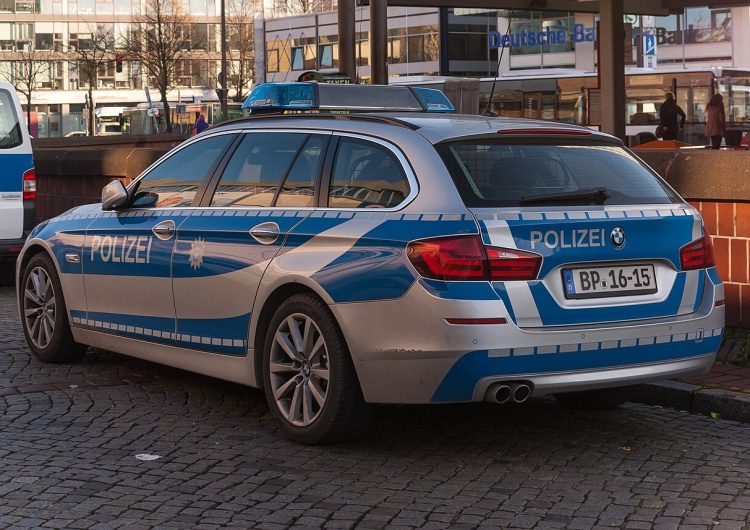
On March 8, in the Polish town of Slubice, a demonstration was held against the practice of abandoning immigrants from Germany in Poland. The practice of the German side came to light nearly a year ago, when the portal Tysol.pl cited figures provided by the German side regarding expelled migrants, which in the first months of 2024 alone exceeded 3,500 persons.
Germany and Deputy Interior Minister Maciej Duszczyk acknowledged as late as June that by the end of May of last year the pace of the practice had further intensified, and more than 4,400 persons had been expelled to Poland. This particular form of expulsion from Germany is closely linked to the border controls that Germany introduced on the border with Poland in the autumn of 2023. This enables Germany to carry out identity checks on persons within a geographic zone of 30 kilometers from the Polish border. If persons checked by the German police cannot produce a valid visa or other document authorizing their stay in Germany, they are classified as illegal migrants and expelled to Poland. Polish authorities began adopting the German interpretation of the matter as early as May of last year, which holds that these persons have not crossed the German state border, because the border is extended by a belt spanning several dozen kilometers. The new Polish-German terminology therefore uses the term "returns from the border."
Polish public opinion learned over the past year not only about the thousands of persons expelled from Germany to Poland, but also about the fact that German police have been known to enter Polish territory and deliver migrants there. Recently, this task has been taken over by the Polish Border Guard, which was recorded picking up an individual on the German side and subsequently delivering them to Polish territory.
When the protest was beginning in Slubice in the early afternoon, the German police suddenly appeared as well. They arrived in a patrol car with 4 or 5 officers. The officers parked their vehicle in front of the protesters on territory belonging to the Republic of Poland. Protesters and the Polish state television broadcaster TVP had the impression that the German and Polish police were jointly providing security for the protest. TVP even reported this information in its television coverage. The German police left before the protest ended. There are witnesses who believe the Germans were present for 10 minutes, while others say it was approximately 30 minutes.
That very same day, I directed an inquiry to the German police in Brandenburg with the following content:
"We have photographs and video footage from participants at today's demonstration in Slubice showing German patrol cars and German police officers in Slubice. How many German police officers and German patrol cars were in Slubice today? How do you explain the presence and activity of German law enforcement on the territory of Poland? Please provide detailed information on the specific regulations that enabled today's deployment."
"We have photographs and video footage from participants at today's demonstration in Slubice showing German patrol cars and German police officers in Slubice."
"How many German police officers and German patrol cars were in Slubice today?"
"How do you explain the presence and activity of German law enforcement on the territory of Poland? Please provide detailed information on the specific regulations that enabled today's deployment."
The German police in Brandenburg responded on March 10:
"Dear Ms. Fedorska, Thank you very much for your inquiry. I wish to inform you that on Saturday, March 8, 2025, there was no crossing of the border onto Polish territory by the Brandenburg state police. Best regards, Spokesperson"
"Dear Ms. Fedorska,"
"Thank you very much for your inquiry."
"I wish to inform you that on Saturday, March 8, 2025, there was no crossing of the border onto Polish territory by the Brandenburg state police."
"Best regards, Spokesperson"
Aleksandra Fedorska replied later on March 10, after 2:00 p.m.:
"Good day, How then were the photographs taken on March 8 at 11:50 a.m. in Slubice? This is a German police officer and a German patrol car. Photograph attached. Sincerely, A. FEDORSKA"
"How then were the photographs taken on March 8 at 11:50 a.m. in Slubice? This is a German police officer and a German patrol car. Photograph attached."
"Sincerely, A. FEDORSKA"
The next exchange of emails was directed to the federal police, which in Germany performs the duties of the border guard. The German side did not respond to the email of March 10, so she renewed her inquiry:
"Good day, On what legal basis can the German police carry out police activities on foreign territory? Video footage from several Polish television stations and from protesters shows a considerably longer period of German police presence and evident police work. For example, the German police were observed directing people not to walk into the street. A German policewoman was filmed during this action. Polish state television reported that the German police were providing security for the protest. I will write to you every day until you respond to me concretely and truthfully on the basis of the press information act. Sincerely, Fedorska"
"On what legal basis can the German police carry out police activities on foreign territory? Video footage from several Polish television stations and from protesters shows a considerably longer period of German police presence and evident police work. For example, the German police were observed directing people not to walk into the street. A German policewoman was filmed during this action. Polish state television reported that the German police were providing security for the protest."
"I will write to you every day until you respond to me concretely and truthfully on the basis of the press information act."
"Sincerely, Fedorska"
Unable to wait for a response, on the 19th I wrote on X:
"Fellow journalists! Please direct inquiries to the German federal police about the legal basis for their actions on March 8 in Slubice. In your inquiries, cite Art. 4, para. 1 of the press law: Authorities are obligated to provide press representatives with the information necessary for the fulfillment of their public duties. The Bundespolizei is not responding to my inquiries concerning the Polish-German border. This behavior is unlawful."
"Fellow journalists!"
"Please direct inquiries to the German federal police about the legal basis for their actions on March 8 in Slubice. In your inquiries, cite Art. 4, para. 1 of the press law: Authorities are obligated to provide press representatives with the information necessary for the fulfillment of their public duties."
"The Bundespolizei is not responding to my inquiries concerning the Polish-German border. This behavior is unlawful."
In less than two hours, the German federal police responded:
"Dear Ms. Fedorska, Thank you for your inquiry and your interest in the Federal Police. Support personnel from the Federal Police Command in Frankfurt (Oder) were in Slubice for approximately ten minutes on March 8, 2025, prior to the start of the gathering, solely for the purpose of establishing contact with the neighboring Polish police. Best regards, Spokeswoman"
"Thank you for your inquiry and your interest in the Federal Police. Support personnel from the Federal Police Command in Frankfurt (Oder) were in Slubice for approximately ten minutes on March 8, 2025, prior to the start of the gathering, solely for the purpose of establishing contact with the neighboring Polish police."
The German police's response was, however, incomplete, as it lacked a legal basis -- a point I raised in a follow-up inquiry.
The federal police's response came very quickly, after 4:00 p.m. on March 19.
"Dear Ms. Fedorska, The legal basis is the Agreement of May 15, 2014, on cooperation between police, border guard, and customs authorities. It regulates, among other things, the mutual exchange of information between the agencies involved and joint police operations, such as joint patrols. Further information can be found on the website of the Federal Ministry of the Interior and Community at: https://www.bmi.bund.de/DE/themen/sicherheit/nationale-und-internationale-zusammenarbeit/grenzueberschreitende-polizeiliche-zusammenarbeit/grenzueberschreitende-polizeiliche-zusammenarbeit-node.html. Best regards, Spokesperson"
"The legal basis is the Agreement of May 15, 2014, on cooperation between police, border guard, and customs authorities. It regulates, among other things, the mutual exchange of information between the agencies involved and joint police operations, such as joint patrols."
"Further information can be found on the website of the Federal Ministry of the Interior and Community at: https://www.bmi.bund.de/DE/themen/sicherheit/nationale-und-internationale-zusammenarbeit/grenzueberschreitende-polizeiliche-zusammenarbeit/grenzueberschreitende-polizeiliche-zusammenarbeit-node.html."
A very thorough legal analysis of this agreement of May 15, 2014, leads to the conclusion that this document does not authorize the German Bundespolizei to carry out activities on Polish territory. Article 5 of the agreement defines a request from the other party as the legal basis for every action. This means that German police officers are only permitted to operate on Polish territory if they are formally requested to do so in writing by a Polish authority.
On March 22, another protest against Germany's practice of abandoning immigrants in Poland took place in Zgorzelec. No German police officers or German patrol cars were seen at the protest.
[Aleksandra Fedorska is a journalist for Polish and German media outlets]