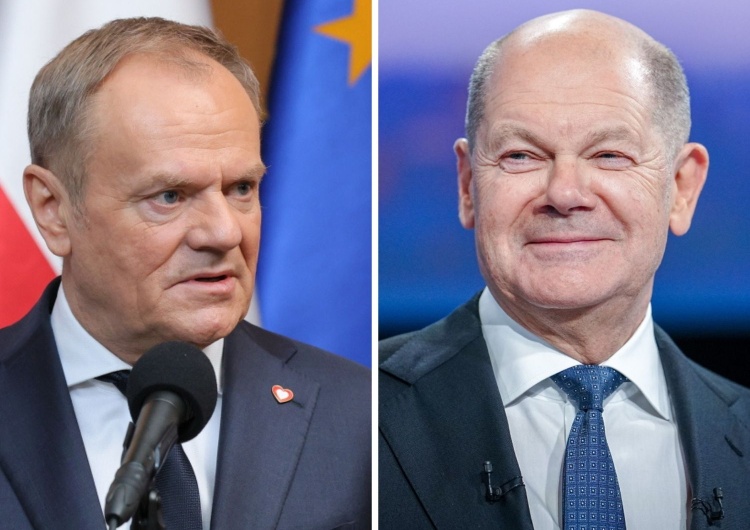
German Chancellor Olaf Scholz, in an interview on the German radio station Deutschlandfunk, assured the interviewing journalist that Polish Prime Minister Donald Tusk would implement the migration pact.
The story was reported by Aleksandra Fedorska, editor-in-chief of the Radio Debata news agency and an expert on German affairs.
As the journalist recounts, during the interview on the German radio station Deutschlandfunk, the interviewer reminded the audience of Prime Minister Donald Tusk's declaration that he would not implement the migration pact. Chancellor Olaf Scholz then replied:
The journalist Fedorska offered a blunt comment on the matter.
Good God, is it now the German Chancellor who dictates the political decisions of our country?
the journalist asked rhetorically.
Prime Minister Donald Tusk has been declaring for months that Poland will not implement the migration pact.
Poland will not implement any migration pact or any provision of such projects that would lead to Poland being forced to accept migrants identified in other European countries,
Tusk has said on multiple occasions. He argued that Poland had taken in many refugees from Ukraine, and moreover that "the relocation mechanism is not a mechanism that protects Europe from illegal migration."
Contrary to the prime minister's narrative, last week MEP Janusz Lewandowski of Civic Coalition (KO) stated that the migration pact would enter into force in mid-2026, and that Poland had failed to assemble a so-called blocking minority to prevent the pact from taking effect.
I know that the pact will enter into force in mid-2026. We failed to assemble a so-called blocking minority against this pact. The countries that gathered to block it represented only 14 percent of the European Union,
Lewandowski declared.
On May 14, 2024, finance ministers of EU member states gave final approval to the migration pact. Three countries voted against: Poland, Slovakia, and Hungary. The pact is intended to comprehensively regulate migration matters in the European Union, including issues related to assistance for countries under migration pressure.
The new regulations are also designed to distribute responsibility for managing migration across all member states. This is to be achieved through a mandatory solidarity mechanism that envisages the relocation of at least 30,000 people per year. It entails providing support to countries under migration pressure by the remaining member states. Alternatively, EU countries will be able to pay 20,000 euros for each person not accepted or participate in operations at the EU's external borders.
German state radio, Deutschlandfunk @DLF at the 20-minute mark: Host: But Donald Tusk said he would not implement the migration pact. Olaf Scholz: He will implement it.... Good God, is it now the German Chancellor who dictates the political decisions of our country? https://t.co/K1Wi3tNetQ — Aleksandra Fedorska (@a_fedorska) February 17, 2025
German state radio, Deutschlandfunk @DLF at the 20-minute mark: Host: But Donald Tusk said he would not implement the migration pact. Olaf Scholz: He will implement it.... Good God, is it now the German Chancellor who dictates the political decisions of our country? https://t.co/K1Wi3tNetQ