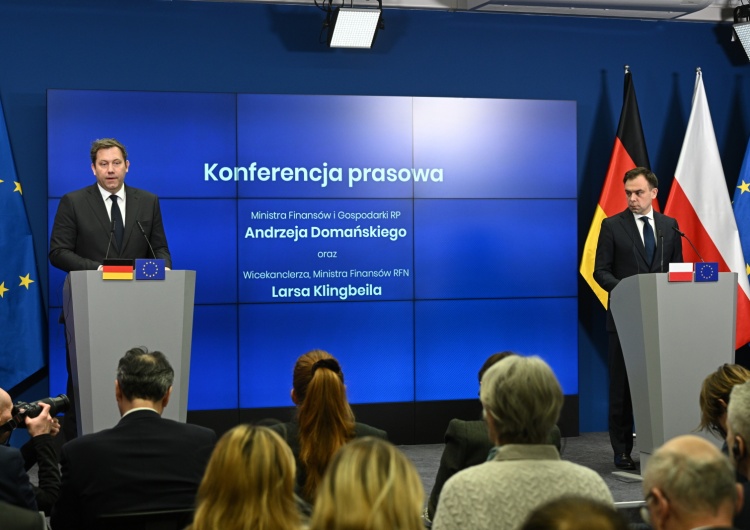
The visit of German Vice-Chancellor and Finance Minister Lars Klingbeil to Warsaw has raised numerous questions. Following his declarations about closer cooperation among key European nations, questions emerged as to whether Poland — by decision of Donald Tusk's government — might join the E6 format, an informal Berlin initiative perceived as a step toward centralizing the Union and weakening transatlantic ties.
Finance and Economy Minister Andrzej Domanski met on Monday with Germany's Vice-Chancellor and Finance Minister Lars Klingbeil.
Continuing with business as usual is no longer possible in Europe. That is why we have joined forces with Poland, France, Italy, Spain, and the Netherlands — not as an exclusive club, but as countries that have committed to accelerating progress. We are preparing decisions in this regard, for example on the European capital market,
said Lars Klingbeil at a joint press conference with his Polish counterpart.
Aleksandra Fedorska, editor-in-chief of Radio Debata and a Germany expert, noted that Klingbeil's statement could mean that by decision of Donald Tusk's government, Poland may be entering the E6 group.
Has the Polish government [of Donald Tusk — ed.] agreed to participate in Berlin's anti-American E6 project?
asks Aleksandra Fedorska, commenting on the German vice-chancellor's remarks.
Foreign-policy analyst and commentator Radoslaw Pyffel also weighed in.
It appears that the Polish government is sending yet another positive signal toward Germany and, by extension, likely toward Germany's E6 proposal. "We need to make Europe more competitive," Polish Finance Minister Andrzej Domanski said at his meeting with Vice-Chancellor Klingbeil (the architect of the E6 concept): "Both Poland and Germany are ready to generate momentum and economic policies that will restore Europe's status as an economic power rather than a regulatory one."
wrote Radoslaw Pyffel on the X platform, quoting Minister Klingbeil, who, in reference to the E6, stated at Monday's press conference that "we have agreed among ourselves on the goal of deepening European cooperation, picking up the pace, and demanding the same from the European Commission."
Are we already on a course toward EU centralization, and will the process accelerate?
Radoslaw Pyffel summed up.
E6 is an informal format of political cooperation among six key European states: Germany, France, Italy, Spain, Poland, and the United Kingdom. It is neither an organization nor a treaty, but a consultative group of governments, used primarily to align positions on security, the war in Ukraine, migration, and European integration. The format is often seen as a Berlin initiative aimed at expediting decisions outside the EU's formal structures, partly following a logic similar to that of the European Political Community.
Chancellor Friedrich Merz and Finance Minister Lars Klingbeil are reviving the concept of Otto II from the Congress of Gniezno and proposing, in the 21st century, something akin to a European empire based on six "provinces." All of this in order to "avoid decision-making paralysis in the Union/Europe." This time the "empire" is to be based not, as a thousand years ago, on E4 (Germania, Italia, Gallia, Slavia) but on E6. Added to the original four are the Netherlands (Holland) and Iberia (Spain). The absence of Scandinavia from the group may raise some controversy. The 21st-century E6 consists of Germany, France, Italy, Poland, Spain, and the Netherlands. Together, 70% of the Union's population. This means the E6 states, acting in concert, could push through virtually any legislation (not to mention forming a blocking minority),
comments Radoslaw Pyffel on the X platform.
At the post-meeting press conference, Domanski noted that economic relations between Poland and Germany "are on an upward curve" and that over 11 months of the previous year, Poland's trade with Germany reached a record level of nearly 160 billion euros. "Poland is an important market for Germany, and Germany is an important market for Polish companies," he stressed.
An additional impulse is needed, and both Poland and Germany are ready to create that impulse and to craft economic policies that will make Europe an economic hegemon once again, rather than a regulatory one,
Domanski added.
He emphasized that the strength of the common European market, with nearly 500 million consumers, must be fully leveraged. "That is our strength. (...) We need to shed the straitjacket of regulation, simplify the law, and reform our markets," he added.
Has the Polish government agreed to participate in Berlin's anti-American E6 project?: — That is why we have joined forces with Poland, France, Italy, Spain, and the Netherlands — not as an exclusive club, but as countries that have promised each other to pick up the pace. We are preparing decisions to that end, on... https://t.co/Dbr0YqU447 — Aleksandra Fedorska (@a_fedorska) February 2, 2026
Has the Polish government agreed to participate in Berlin's anti-American E6 project?: — That is why we have joined forces with Poland, France, Italy, Spain, and the Netherlands — not as an exclusive club, but as countries that have promised each other to pick up the pace. We are preparing decisions to that end, on... https://t.co/Dbr0YqU447
It appears that the Polish government is sending yet another positive signal toward Germany and, by extension, likely toward Germany's E6 proposal. "We need to make Europe more competitive," Polish Finance Minister Andrzej said at his meeting with Vice-Chancellor Klingbeil (the architect of the E6 concept)... https://t.co/AoducsTmT4 pic.twitter.com/4pB16MKYAW — Radek Pyffel (@RadekPyffel) February 2, 2026
It appears that the Polish government is sending yet another positive signal toward Germany and, by extension, likely toward Germany's E6 proposal. "We need to make Europe more competitive," Polish Finance Minister Andrzej said at his meeting with Vice-Chancellor Klingbeil (the architect of the E6 concept)... https://t.co/AoducsTmT4 pic.twitter.com/4pB16MKYAW