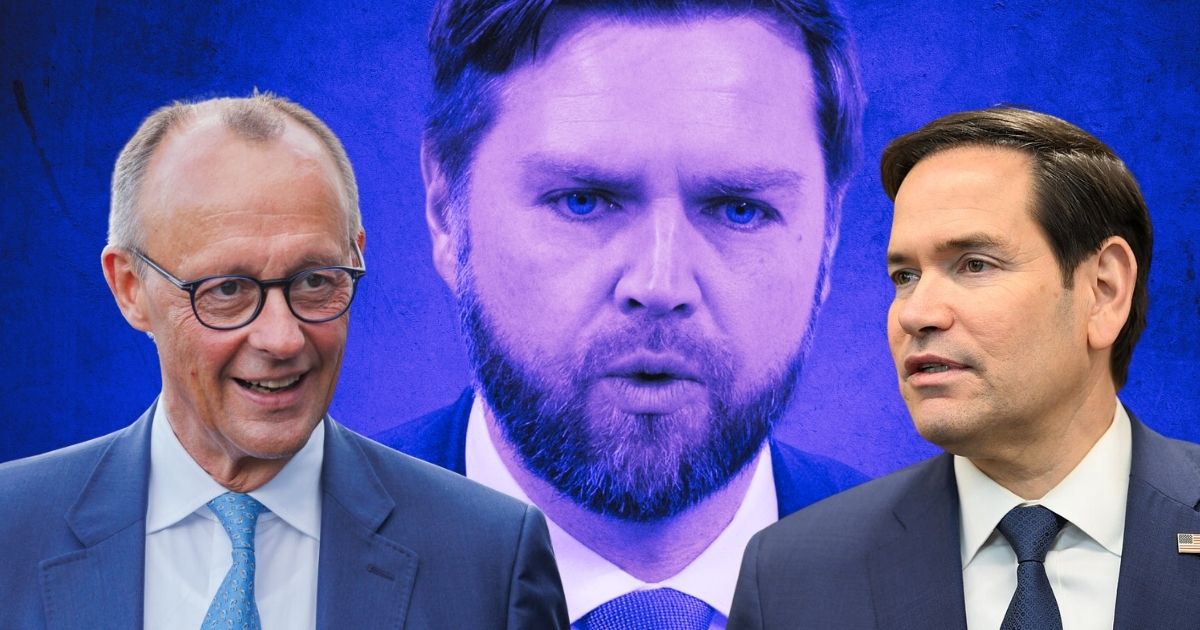
A year ago, J.D. Vance declared that the greatest threat to Europe comes not from outside — Russia, China, or other powers — but from within the continent, the result of an erosion of fundamental democratic values, freedom of speech, freedom of the press, and a crisis of governmental legitimacy.
Vance's speech triggered a firestorm — accusations of meddling in Europe's internal affairs, charges of supporting the "far right," and praise for his "candor" and "waking up the Europeans." Many commentators deemed it a turning point in transatlantic relations, symbolizing a departure from the longstanding narrative of "shared values" in favor of hard conditionality for the alliance. In response, the organizers of MSC 2026 are striving to ensure that this year's edition (February 13–15, 2026) focuses more squarely on current issues rather than a replay of last year's ideological confrontation.
European leaders want to avoid another public humiliation at Washington's hands.
Although Chancellor Friedrich Merz's keynote address will take place at the opening of the conference on Friday, February 13, 2026, the most important overseas guest this year — U.S. Secretary of State Marco Rubio — will deliver his speech on Saturday, the second day after the event's official start.
In German media outlets such as Der Spiegel, Suddeutsche Zeitung, and Frankfurter Allgemeine Zeitung, fears dominate of a potentially sharp broadside from Rubio, who serves not only as America's top diplomat but also as acting national security adviser to President Donald Trump.
Those fears are entirely warranted, because the list of confirmed or likely conference attendees includes some of Trump's fiercest political adversaries, among them prominent Democrats such as California Governor Gavin Newsom, Congresswoman Alexandria Ocasio-Cortez (AOC), and Michigan Governor Gretchen Whitmer. This lineup — Rubio as Trump's hawk versus Democratic rivals — could turn MSC 2026 into the arena of a proxy fight over America's future. The Democrats are searching for a new leader. Newsom looks promising so far and is leading, but Whitmer and AOC also represent important, powerful factions. If Rubio attacks as Vance did in 2025 — "Under Donald Trump's leadership, we may disagree with your views, but we will defend your right to offer it in the public square" — this conference could become a turning point in transatlantic relations.
An unforeseen Polish angle has also emerged around the MSC, as for many months the conference's chairman, Wolfgang Ischinger, has been presenting to the German public his idea for repairing Polish-German relations, which in his view suffer primarily from Polish reparations demands directed at Germany. This esteemed expert and seasoned political scientist spent many years at diplomatic posts, including in Washington. In his view, Germany should give Poland armaments — such as tanks or submarines — instead of money, thereby closing the reparations issue once and for all.
The German public reacted with indignation to Ischinger's remarks, as the prevailing view in Germany is that the reparations question simply does not exist. Ischinger was therefore compelled to clarify: "I, too, reject these reparations claims. I did not say we should deal with reparations claims. I simply said that they exist and are a burden on our bilateral relations. (...) Poland, like the Baltic states, now plays the role of a frontline state — the role that we Germans played during the Cold War. (...) At that time, we were relatively grateful that the Americans stationed hundreds of thousands of soldiers in Germany without demanding a penny from us, and that they brought thousands of tanks. It cost us nothing at the time, but it guaranteed our security."
On February 9, Wolfgang Ischinger presented a publication prepared by MSC experts outlining the key directions of security and defense policy over the past year. The report, titled "Under Destruction," authored by Tobias Bunde and Sophie Eisentraut, portrays Trump as a demolition man — someone who sows destruction while promising reconstruction, but who in reality undermines the political order.
The U.S. administration, according to the report, has rejected multilateralism, open trade, and the promotion of democracy in favor of transactional deals. Ischinger emphasized that the changes in U.S. policy are enormous, and Vance's remarks from the previous year most clearly illustrate this administration's deep aversion to the liberal consensus. Sophie Eisentraut added that Europe can no longer rely on a policy of appeasement in the face of the bulldozer politics of great powers. Bunde, for his part, said that "Trump challenges multilateralism, seeing it as a constraint on power." This is not merely a diagnosis — it is a call to action for Europe, to which Ischinger declared: "Europe must show that it has understood and will act in unison."
In German think tanks such as the MSC and the affiliated Internationale Politik Quarterly, there is a consensus that the era of so-called Westlessness — the dissolution of shared Western values — has become a reality. The Trump doctrine of "America First" is not a passing whim but a structural shift that puts Europe to a severe test.
Washington, in the view of many German experts, is gradually withdrawing from its role as a security guarantor, vacillating on support for Ukraine and hurling threats toward Greenland, deepening the sense of uncertainty on the continent. The MSC report warns: the world has entered an era of wrecking-ball politics, in which powers such as the United States, China, and Russia demolish rules in order to build new ones based on hegemonic strength.
In this context, Germany's intellectual elites, from Berlin to Munich, see transatlantic relations less as a partnership and more as a toxic relationship full of reassurances, conditionality, and coercion. "Low trust" is the leitmotif of virtually every recent report on relations with the United States, such as "Low Trust: Navigating Transatlantic Relations under Trump 2.0," produced by the EU Institute for Security Studies. Europe, once a passive consumer of U.S.-guaranteed security, must quickly become a provider of its own. That means increasing defense spending, reforming the arms industry, and avoiding individual-state vetoes in EU decisions. This is not a lament — it is a manifesto of sovereignty. As the report underscores, more than 80 years after the construction of the postwar order, the United States under Trump is becoming its demolisher, and Europe, if it fails to respond, could become the next victim of the "Trump demolition." MSC 2026 will be a test for the Old Continent.
In his final official address to the Bundestag on the state of foreign policy, Merz stressed that the world has changed and this "new world [is the terrain] of great powers" — a world "based on strength, power, and — if need be — force as well." "Such a world is not a cozy place," he said literally. The German Parliament had not heard such words since its establishment in 1949.
This year's MSC is promoting Germany as the leader of a new world order. On Friday, German Chancellor Friedrich Merz is expected to deliver one of the most important speeches of his career on the subject. It all gives the impression of a manifesto against Trump and a call for German self-realization beyond the alliance with the United States. In Berlin's view, it is a chance for a "European renaissance" — under its command.