German Interior Minister Nancy Faeser on Tuesday banned the publication of the monthly magazine "Compact," calling it "the main mouthpiece of the right-wing extremist scene." Journalist and German affairs expert Aleksandra Fedorska believes the decision to shut down "Compact" will be ineffective and will not halt the rising popularity of the right in Germany.
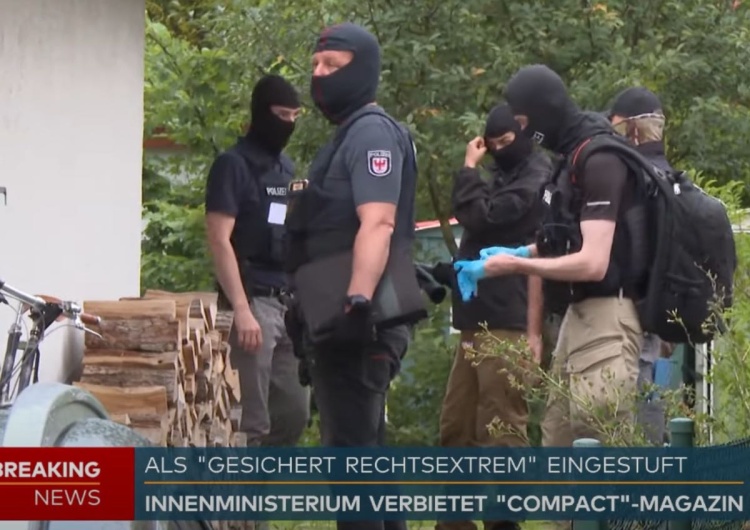
German Interior Minister Nancy Faeser on Tuesday banned the publication of the magazine "Compact," which had been classified as extremist by the domestic intelligence service. She also dissolved the publishing company Compact-Magazin GmbH and its subsidiary Conspect Film GmbH.
Faeser said the magazine is "the main mouthpiece of the right-wing extremist scene" and that it "incites hatred against Jews, people of migrant background, and German parliamentary democracy."
On Tuesday, raids were conducted from the early morning hours at locations associated with Conspect Film GmbH, as well as at the homes of its executives and shareholders in Brandenburg, Hesse, Saxony, and Saxony-Anhalt. The home of Juergen Elsaesser, the magazine's editor-in-chief, was also searched.
The police raid on Elsaesser's home on the outskirts of Berlin took place at 6 a.m. The 67-year-old opened the door in a bathrobe. According to the Tagesspiegel, officers were looking for large sums of cash in addition to securing documents and data storage devices.
When asked by journalists outside his home, Elsaesser stated that "Compact" magazine had never been convicted of crimes such as incitement to hatred, racism, antisemitism, or incitement to violence.
The editor-in-chief of "Compact" magazine claimed that the German Interior Ministry's actions were aimed at intimidating opposition media so that only pro-government outlets would remain. He noted that the magazine's and its television channel's popularity had surged. Elsaesser also believes that these actions are intended to weaken the opposition party AfD.
"Compact" is a monthly magazine published since 2014, with estimated sales of around 40,000 copies (for comparison: the weekly "Der Spiegel" sells an average of 650,000 copies, the weekly "Stern" around 300,000, and "Focus" magazine around 240,000).
Journalist Aleksandra Fedorska, speaking with Tysol.pl, emphasized that "Compact" can be understood not merely as a magazine but as a collection of various right-wing circles. "'Compact' was associated with various right-wing milieus, including controversial ones such as the Reichsbuerger movement," she said.
"The content published in 'Compact' magazine was controversial, often with very unfavorable consequences for Poland, for example. I disagree with the content of this magazine. I disagree with its pro-Russian content and the whitewashing of German history that took place in the publication. Nevertheless, I believe this is a very far-reaching decision and an ineffective one. If you ban such content, the ideas themselves will not simply disappear,"
Fedorska stressed.
According to the journalist, German Interior Minister Nancy Faeser wants to gain "political breathing room" with this decision and did it for show. "Will the decision achieve its intended effect and halt the rise of right-wing sentiment? I don't think so," she emphasized.
Aleksandra Fedorska also pointed out that during the European Parliament election campaign, a spy scandal erupted in the circles around the AfD party, which ultimately did not harm the party.
"I don't think [the German Interior Ministry's decision — ed.] was a good idea. It will produce the opposite of its intended effect. (...) 'Compact' magazine's circulation was small — let's not exaggerate its significance. The AfD's environment is primarily social media, where they are very strong,"
Aleksandra Fedorska noted.