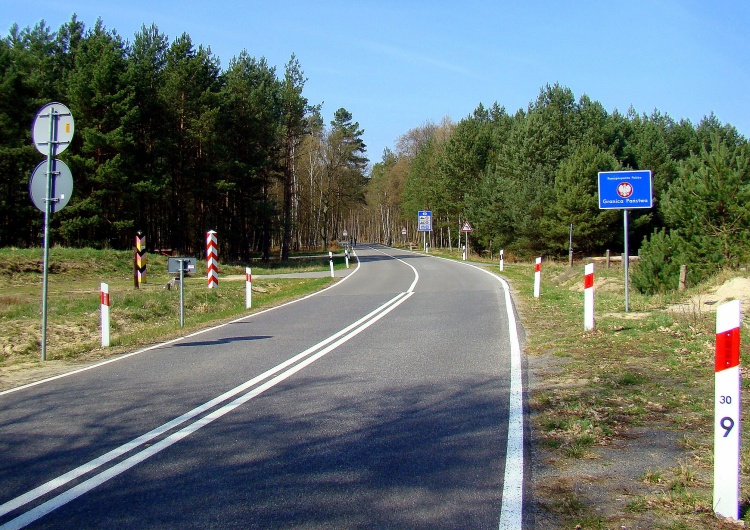
"The problem at the Polish-German border persists. Nearly 10,000 expulsions from Germany to Poland!" reports editor Aleksandra Fedorska, editor-in-chief of the Radio Debata news agency.
Urgent news on the subject of expulsions [of immigrants — ed.] from Germany to Poland related to the introduction of border controls on the German side. This enables Germany — through administrative procedures — to expel people who are already on the German side. (...) In the so-called border zone, which has been expanded to include highways and train stations, already at a distance of 50 or even 30 kilometers from the border with Poland, with the Czech Republic, and with other countries, checks are being conducted. If during a check someone cannot produce a document authorizing their stay in Germany, such as a visa, they are expelled. If this happens near the Polish-German border, they are expelled to Poland,
editor Fedorska explained the background. The journalist emphasized that she had waited a long time for updated figures from the German side.
And now the German Interior Ministry gives the number of 8,950 such expulsions, but from December to September. Assuming approximately one thousand expulsions per month, one must assume that the current figure is around 10,000,
the editor emphasized. Later in the broadcast, she referred to a "new development associated with this announcement."
Until now, in the context of this administrative procedure — it is very interesting — it is only possible in the context of the introduction of border controls. If one country introduces border controls and the other country is effectively still in Schengen, then it is practically defenseless. Germany argues that the border crossing did not actually take place. That the person caught in the border zone never actually crossed the border. But of course they did cross it and were physically present in Germany. There is a dissonance between the Polish side, which is still in the Schengen reality, which knows no border controls, and the other [German — ed.] side, where there is a return to the pre-Schengen state,
editor Fedorska pointed out.
The above data come from the German Ministry of the Interior. We are sharing the email from the spokesperson of the Federal Ministry of the Interior.
The temporary reinstatement of controls at internal borders is based on the legal requirements of Regulation (EU) 2016/399 (the Schengen Borders Code). For migration policy and security reasons, the Federal Ministry of the Interior has also ordered the temporary reinstatement of controls at internal borders on the land border with Poland, most recently with effect from June 16, 2024, to December 15, 2024. The Federal Ministry of the Interior is also in good and trusting contact with its Polish partners at all levels in this regard,
the German Interior Ministry stated. According to the ministry, "if, as a result of the temporarily reinstated controls at internal borders — including on the Polish-German land border — third-country nationals who do not meet entry requirements are identified, measures to prevent entry will be analyzed on an individual basis and, where necessary, implemented."
In this context, the federal police ordered approximately 8,450 entry-prevention measures on the Polish-German land border in the period from December 2023 to September 2024,
the ministry reports.
The problem at the Polish-German border persists https://t.co/A3AGSz6qz6 — Aleksandra Fedorska (@a_fedorska) November 18, 2024
The problem at the Polish-German border persists https://t.co/A3AGSz6qz6