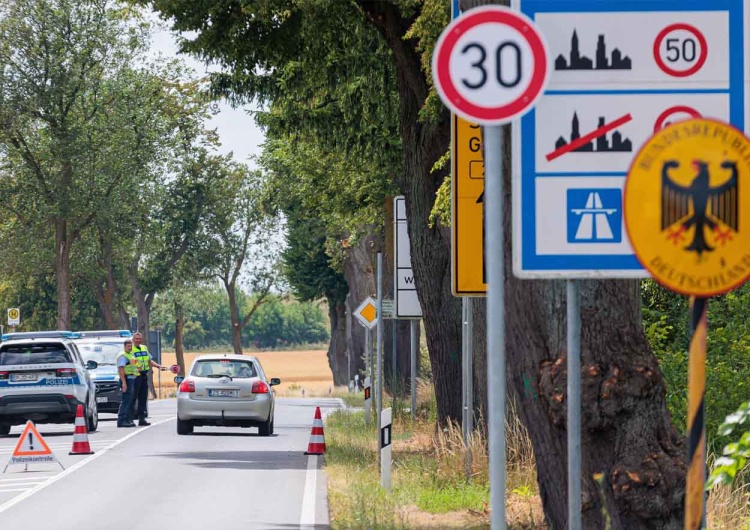
The German federal police reported that it had intercepted a drone approaching from Poland. The police are considering criminal and administrative proceedings against the drone operator.
Journalist Aleksandra Fedorska published an email she received from a spokesperson of the Federal Police Headquarters in Bad Bramstedt. Germany stated that on July 5, 2025, at approximately 6:30 p.m., personnel in the border area near Blankensee detected an unmanned aerial system (UAS) approaching from Polish territory.
The police technical unit repelled the drone attack by disrupting the reception frequency using the police's technical capabilities. The unmanned aerial vehicle automatically switched to return mode, returning to its remote pilot or another starting position. The unmanned aerial vehicle was not forced to land, but was prevented from continuing its flight into German territory and over or near the emergency services,
the message reads.
Thank you very much for your inquiry and your interest in the Federal Police. I will respond to your inquiry as follows: On July 5, 2025, at approximately 6:30 p.m., emergency services in the border area near Blankensee detected an unmanned aerial system (UAS) approaching the forces deployed in the border zone from Poland on the other side of the border line. The police technical unit repelled the drone attack by disrupting the reception frequency using the police's technical capabilities. The unmanned aerial vehicle automatically switched to return mode, returning to its remote pilot or another starting position. The unmanned aerial vehicle was not forced to land, but was prevented from continuing its flight into German territory and over or near the emergency services. Section 21h of the Air Traffic Regulations (LuftVO) governs so-called geographic areas. (...) A minimum distance of 100 meters on all sides from security agencies must be maintained (...). The police may take all necessary measures to prevent such threats as part of threat prevention. The police are examining the possibilities of initiating criminal or administrative proceedings against the unmanned aerial vehicle pilot responsible for the LuftVO violations.
Thank you very much for your inquiry and your interest in the Federal Police. I will respond to your inquiry as follows:
On July 5, 2025, at approximately 6:30 p.m., emergency services in the border area near Blankensee detected an unmanned aerial system (UAS) approaching the forces deployed in the border zone from Poland on the other side of the border line. The police technical unit repelled the drone attack by disrupting the reception frequency using the police's technical capabilities. The unmanned aerial vehicle automatically switched to return mode, returning to its remote pilot or another starting position. The unmanned aerial vehicle was not forced to land, but was prevented from continuing its flight into German territory and over or near the emergency services.
Section 21h of the Air Traffic Regulations (LuftVO) governs so-called geographic areas. (...) A minimum distance of 100 meters on all sides from security agencies must be maintained (...). The police may take all necessary measures to prevent such threats as part of threat prevention.
The police are examining the possibilities of initiating criminal or administrative proceedings against the unmanned aerial vehicle pilot responsible for the LuftVO violations.
Section 21h of the LuftVO introduces geographic no-fly zones, including the obligation to maintain a distance of at least 100 meters from security services. Illegal violation of this zone can result in heavy penalties.
The Bundespolizei has announced a legal analysis and possible action against the pilot. Possible sanctions include both administrative fines and criminal liability if the incident is classified as a threat to life or health.
According to a press release from Germany's Federal Ministry of the Interior (BMI) sent to the Polish outlet Wirtualna Polska:
BMI spokesperson Mehmet Ata stated that following an order dated May 7, 2025, the federal police may also return persons who have filed asylum applications. Since May 8, approximately 1,300 persons have been returned, including 130 asylum applicants. The police state that they are striving to minimize disruptions to traffic.
"The federal police are ensuring the greatest possible freedom of cross-border movement of persons and goods and are constantly reviewing appropriate measures to keep any disruptions to traffic to a minimum," Ata noted.
The Border Defense Movement (Ruch Obrony Granic) is a nationwide civic initiative founded by Robert Bakiewicz, whose goal is to defend Poland against mass migration and the threats associated with it. It is not only about protecting physical borders but also about defending our national identity, culture, and social community by exerting pressure across the entire country.
As stated on the organization's website, the Border Defense Movement opposes plans that could lead to the forced settlement of migrants in Poland and the alteration of the structure of our society. The movement's task is to build public awareness, organize citizens, and influence state policy, always in a manner consistent with the law and in the spirit of patriotism.
Robert Bakiewicz, the founder of the Border Defense Movement, stated that he will not be intimidated by Prime Minister Donald Tusk.
"I must be prepared for attempts to detain me, to break up our patrols, and to outlaw civic dissent. I have been through this before," he declared.
"I do not rule out the possibility of false accusations, fabricated evidence, and mystifications designed to create the appearance of legality for a potential detention and imprisonment. All of this has happened before," he added.