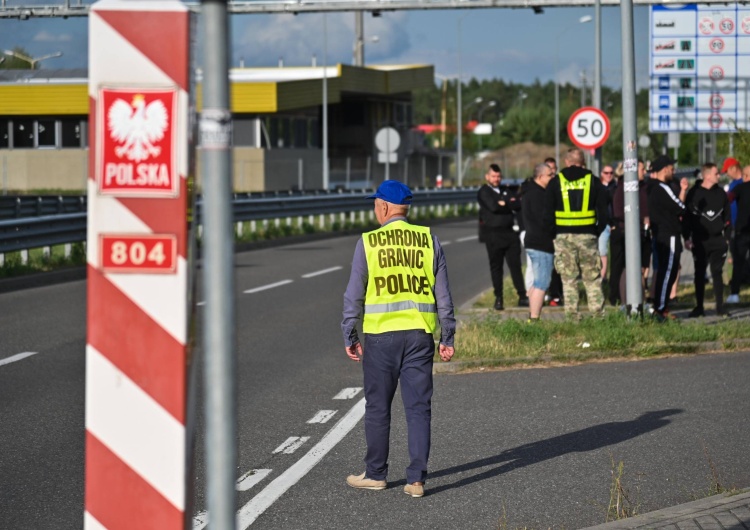
According to the statements of Aleksandra Fedorska, a journalist for Tysol.pl among other outlets and an expert on German affairs, the authorities in Berlin may be seeking to weaken or dismantle the Border Defense Movement, which is hampering the effective expulsion of migrants to Poland.
"They need to expel 1,000-1,500 migrants per month in the direction of Poland. Those are the quotas they managed to achieve last year,"
Fedorska said on Radio Wnet. She added that German services receive praise from their own politicians for these results, but currently -- due to the actions of the Border Defense Movement -- they are unable to maintain that scale. The journalist warns that the German authorities may attempt to dismantle the grassroots initiative defending the Polish border through mechanisms already used in the past.
"This succeeded in the Netherlands. (...) They will try to achieve it the same way: split the movement and tell those who are moderate that there will be very dangerous consequences for them if they side with the radicals,"
Aleksandra Fedorska pointed out.
As the journalist notes, provocation using controversial symbolism is a scenario that has already occurred in the West.
"A provocation will probably emerge soon involving some Nazi-fascist symbolism,"
Fedorska predicts, suggesting that such actions are intended to be deliberately staged in order to discredit the entire movement as extremist, anti-immigrant, or racist.
Fedorska also notes that local German media are beginning to write about the situation on the Polish border in accusatory language.
"They speak of 'witch hunts,' of the creation of racist situations,"
The Border Defense Movement (Ruch Obrony Granic) is a nationwide civic initiative founded by Robert Bakiewicz, whose goal is to defend Poland against mass migration and the threats associated with it. It is not only about protecting physical borders but also about defending our national identity, culture, and social community by exerting pressure across the entire country.
As stated on the organization's website, the Border Defense Movement opposes plans that could lead to the forced settlement of migrants in Poland and the alteration of the structure of our society. The movement's task is to build public awareness, organize citizens, and influence state policy, always in a manner consistent with the law and in the spirit of patriotism.
The German police regularly report on the return of illegal immigrants to Poland. In March, the head of the German deportation center in Eisenhuttenstadt, Olaf Jensen, in a conversation with Wirtualna Polska, praised Warsaw's stance on immigrants.
"Poland is one of the most concrete, most correct, and most efficient states in Europe in this regard: it responds quickly, in compliance, and always favorably. In short: you can cooperate well with Poland. There is great potential to simplify transfers between Poland and Brandenburg and to make procedures more efficient for both sides,"
Under the Dublin III Agreement, EU countries agreed that asylum procedures take place in the country to which the migrant arrives in Europe. In the event that a person ends up in another country, that country has the right to send them back to the country where they crossed the EU border. However, Italy, Spain, and Greece typically allow arrivals to travel freely and subsequently do not take them back.
Germany will try to dismantle the Border Defense Movement. @a_fedorska for @RadioWNET: Probably, because that is what was done in the Netherlands as well. A provocation will be organized with some Nazi-fascist symbolism. (...) Germany also in its press articles... pic.twitter.com/iAbvfYZyIZ -- Lukasz A. Jankowski (@LAJankowski) July 1, 2025
Germany will try to dismantle the Border Defense Movement. @a_fedorska for @RadioWNET: Probably, because that is what was done in the Netherlands as well. A provocation will be organized with some Nazi-fascist symbolism. (...) Germany also in its press articles... pic.twitter.com/iAbvfYZyIZ