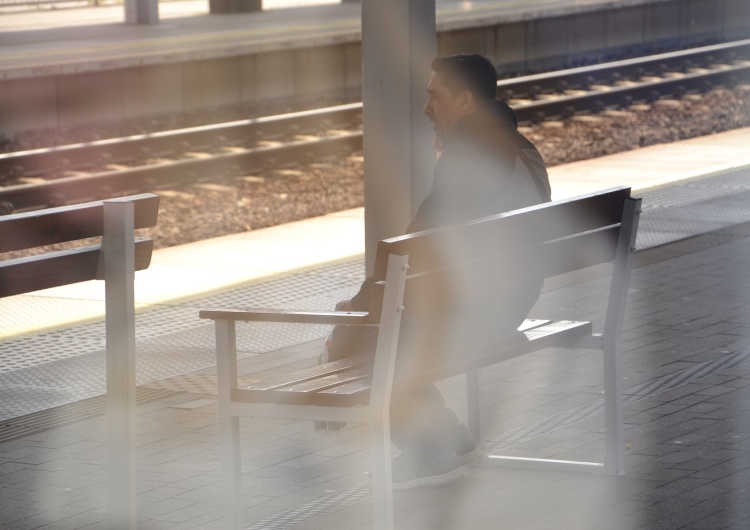
Janusz and Bartosz Sulczewski are people with big hearts. The father-and-son duo have extensive experience in helping those in need. Their social cooperative, which has been operating since 2005, runs several shelters in the Lubusz Voivodeship. The problem intensified in January of this year, and surprisingly, the center in Zielona Gora has been particularly affected, where since the beginning of the year an increasing number of people of Arab, Asian, and African origin deported from Germany have needed assistance.
Roma Mucha, a local human rights activist who works with the "Miejsce na ziemi" [A Place on Earth] foundation, faces the same challenge. The Polish Border Guard is so severely overburdened that, as Ms. Mucha recounts, they once even gave the activists' private home as an address where people deported from Germany could find shelter.
Tusk Wants the Power to Deploy the Military on the Streets
The German Federal Police acknowledged that in the first four months of this year, they deported as many as 3,578 persons who had been on German territory to Poland. According to German officials, these individuals are part of a group of 5,621 people who illegally crossed the Polish-German border. In addition, during the aforementioned period, the Federal Police deported a total of 178 persons to Poland and turned back 86 others. The Federal Police reports that it does not yet have any statistical data for May 2024. But it was precisely May that, according to those engaged in helping desperate foreigners, was the most difficult month in this regard. They therefore fear that the number of persons deported by Germany will intensify further. Help from the city and awareness of the problem are urgently needed at last. For months, the Lubusz region has been simmering and sounding the alarm, but the authorities refuse to hear about the problems. The Border Guard in Tuplice, which takes custody of these people deported from Germany, may be acting in good faith when it merely presses a slip of paper into their hands with addresses of immigrant assistance points. But what good does that do when soup kitchens are open only from 7:00 a.m. to 3:00 p.m. and have no overnight accommodation? The voivodeship must have 24-hour aid institutions for persons deported from Germany, which are often in poor condition.
The Sulczewskis will not turn away people in need — that is not who they are. A hungry person gets bread and a place to sleep. Basic humanitarian principles. When a man without shoes arrived at the center recently, Janusz Sulczewski took off his own slippers and gave them to the man, whose feet were covered in wounds from walking barefoot. "These people who end up at our place from the border post in Tuplice are terrified. Sometimes three days pass before they understand they are not in prison. Most of them don't know what a shelter is," explains Bartosz Sulczewski. Those who, after deportation by Germany, went through processing at the post in Zielona Gora-Babimost tend to be calmer. Janusz Sulczewski also notes this.
The German Border Guard Mistreats Immigrants
"Treating bad"
— this is a statement that has been made more than once in the context of the German police, Bartosz Sulczewski tells us.
Roma Mucha confirms that the German border guards mistreat people. Recently her organization dealt with a small group of people whom the Germans had abandoned in a forest. These people wandered disoriented for two weeks in the border zone. Their condition was very serious by the time they came under the care of activists.
The Lubusz region is not wealthy. In fact, the region is still doing its best to cope with the challenges posed by Ukrainians who arrived there fleeing the war in their country. This group includes a great many women and children. At the Caritas aid point, lines form in the afternoon hours.
Young men deported from Germany also need food and shelter, but their needs extend to financial matters as well. They declare that they have nothing on them. In general, it should be noted that these individuals, being in a difficult situation, sometimes bend the truth in their statements to achieve their goals.
On the ground, they try to organize money. They ask for access to bank accounts for transfers from abroad. On the Polish side, there are individuals who agree to such things, perhaps unaware that this could be exploited for dangerous purposes.
Foreigners are also constantly interested in obtaining smartphones. From their perspective, it is the only way to maintain contact with their world. Conflicts have already arisen at assistance centers in the Zielona Gora area precisely over this issue.
Meanwhile, documents have emerged indicating that Germany is exploiting the indecisiveness of Polish authorities and, as a rule, determines that undocumented persons are to be deported to Poland. This fate also befell a 21-year-old dark-skinned cyclist on highway No. 11 near Penkun, a town located 5-7 kilometers from the Polish border. The man was stopped by police at 12:00 p.m. on June 3. He had no documents on him, only a bicycle. The local press described the case with satisfaction, as the man had already been deported to Poland by 6:30 p.m. The basis for deportation to Poland was reportedly his testimony, in which he told police verbally that he had paid 14,000 euros to be smuggled through Belarus and traveled to Riga by taxi. According to his testimony, he then bought a bicycle in Latvia, traveled by bus and train to the border, and then crossed the Polish-German border by bicycle. Even in such a case, Germany manages to distort the laws about the supposed first safe country and deport him to Poland, despite the fact that the man affected by the deportation reportedly said he entered the EU through Latvia and then allegedly continued on to Lithuania. But the Germans have little interest in facts or logical reasoning when it comes to migration. What matters is making an impression on German citizens that migration is being effectively combated. And indeed, they are increasingly successfully deporting more people to Poland. This is possible only because the Polish Border Guard accepts the Germans' arguments which — as the Penkun example shows — are neither logical, nor substantive, nor lawful.
Aamin Muridi Abdulkadir, presumably from Somalia, was transferred to the Border Guard post in Tuplice. A protocol drawn up by Zuzanna Matusiewicz on May 26 indicates that Abdulkadir had previously been on German territory, near Klein Bademeusol, when he was detained by German police. The protocol clearly indicates that no asylum application was filed in Germany. However, a person providing the same personal details appeared again in the Border Guard's records in Tuplice on May 28, having been caught by the Polish side attempting to cross the border into Germany.
Documents from the Federal Police in Frankfurt an der Oder, as well as protocols compiled by the Polish Border Guard, show that when deporting these people to Poland, Germany invokes the Dublin III arrangements of 2013. However, the Dublin procedure in these cases is nothing but an abuse, since it was created to ensure that each asylum application filed on the territory of member states is examined by only one state in terms of substantive law. In the three above-mentioned documented cases, no asylum application was filed in any EU member state.
If there are indications that an asylum application was filed within the borders of another member state, the files in Germany must be forwarded to the Dublin Center of the Federal Office responsible for the given location in order to initiate the Dublin procedure. If the analysis conducted by the Dublin Center determines that another member state may be responsible for examining the asylum application, a so-called takeover request is sent to the member state in question. That member state must consent to taking the person. Only then does the Federal Office order deportation to the responsible member state.
The person affected by this procedure may appeal the decision and file a motion with the competent administrative court for a suspensive order under Section 80(5) of the VwGO. Transfer to another member state is not permitted before the court issues its decision on the appeal.
How crudely and in disregard of the rule of law deportations from Germany to Poland are carried out is illustrated by the case of a person referred to by the German Border Guard from Frankfurt an der Oder as "Jammal." The Federal Police Inspectorate issued an entry ban to Germany against Jammal. The decision to deport Jammal from Germany was linked in his case to deportation to Poland, as recorded in a document dated May 13, 2024. German police officers state in writing that they are deporting Jammal because they associate him with an event that occurred near his location and constituted unauthorized entry into German territory. They provide no evidence.
Police note that Jammal had no documents on him and is therefore immediately prepared for deportation from Germany. The document contains a clause about the possibility of appealing the decision, but the deportation is executed immediately. This document, drawn up by the German police, was not signed by Jammal, who refused to sign it. Despite this, Germany deported him to Poland.
According to Bartosz Sulczewski, the people arriving in Poland from Germany so far are men in their prime. In his assessment, they are individuals in the 30-40 age range. The vast majority of them are severely psychologically broken and burdened with health difficulties, but their physical condition has not yet required medical consultations. At the same time, the Sulczewskis are troubled by the mental difficulties they encounter in dealing with these people. These foreigners function as if outside the community that resides at the shelter. It is a community that follows the rules of the place, and the overwhelming majority are middle-aged and elderly people of Polish origin. The foreigners do not integrate with them. They eat in the hallway or in their rooms. So far, Germany is not deporting women or children to Poland.
A new phenomenon is the significant increase in the proportion of Persian-speaking individuals. The Sulczewskis have grown accustomed to communicating in English or through a translator on a smartphone. Previously, one only needed to set the language to Arabic to convey basic information, but recently the newcomers want to communicate in Persian and declare that they come from Iran. One of these individuals reportedly said he had worked as a policeman in his home country. Witnesses remembered this Iranian as a very self-assured man who gave a well-groomed impression — and he too had been deported from Germany and handed over to the Border Guard.
In the past, it was easy to cross from Poland into Germany, but since mid-October 2023, when Germany introduced stationary controls and checks in border regions alongside a tightening of German migration policy, attempts to cross into Germany often fail. Sometimes individuals try to cross the border as many as three times and are sent back to Poland. A popular strategy is trying to look like a European. In the view of the foreigners, one only needs to look somewhat like a well-dressed European for the German police not to stop and deport them. But in recent months, it has become increasingly difficult for people of color to get through to Germany. Those who stay in Poland fall into depression and desperation. While in Poland, they have no means of subsistence and cannot function in our society, which is unknown and entirely foreign to them. These individuals quickly begin forming connections among themselves that at times also alarm the Sulczewskis. There are reasons to believe that people-smuggling networks are already forming in the Lubusz region. This is a dangerous milieu from which many problems may arise for this impoverished area, which even without foreigners has enormous difficulties.
I obtained a document from the interrogation protocol of a person identified as Jammal in Germany. The Federal Police in Frankfurt an der Oder deported him from Germany to Poland and prohibited his return. Jammal refused to sign this document and was deported to Poland. A story as horrifying as... pic.twitter.com/TigiWe0DfV — Aleksandra Fedorska (@a_fedorska) June 10, 2024
I obtained a document from the interrogation protocol of a person identified as Jammal in Germany. The Federal Police in Frankfurt an der Oder deported him from Germany to Poland and prohibited his return. Jammal refused to sign this document and was deported to Poland. A story as horrifying as... pic.twitter.com/TigiWe0DfV